One of the empire’s that I’ve always found super interesting is the Byzantine Empire and I’ve always been aware that I haven’t covered it enough on this blog so I decided now would be as good a time as any, especially as today is the anniversary of the death of Empress Theodora Porphyrogenita (980-1056) who was the final monarch of the Macedonian dynasty that ruled the Empire. I’ve always wanted to do something on this blog about her and her sister Zoe but never got round to it so here is a post mostly about Theodora but also with a bit of Zoe!. Hope you enjoy!
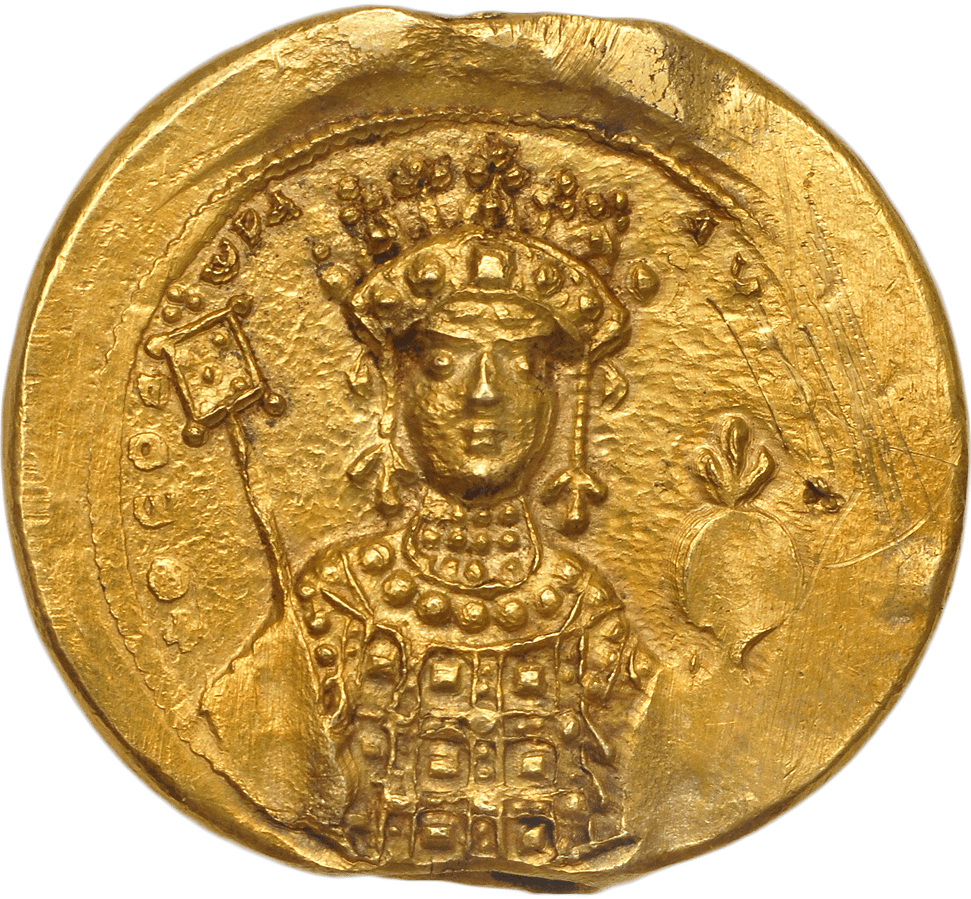
Theodora was born circa 980 the youngest daughter of Emperor Constantine VIII and Empress Helena; information about her mother’s origins are scarce. The Porphyrogenita part of her name means “born to the purple” a title given to a prince or princess born during their father’s reign as opposed to being born before their father’s accession. It’s a reference to Tyrian purple a colour in the Byzantine Empire that was so rare and expensive that it was used only by the Imperial family (fun fact – Tyrian purple is a reddish-purple natural dye that coms from several species of sea snails – the name Tyrian refers to Tyre, Lebanon, formerly Phoenicia where there was an abundance of these snails). Theodora was the youngest of three daughters that lived to adulthood – Eudokia, Zoe & Theodora. At the point she was born, her father was not the sole Emperor – he ruled alongside his brother Basil II from 976 to 1025. Now her father was not a particularly good Emperor; he demonstrated a lifelong lack of interest in politics despite being either a co-Emperor or sole Emperor for 66 years. In 996 when she was around 15-16, Theodora was considered a potential bride for Otto III the Holy Roman Emperor however negotiations fell apart. In 1002 another embassy was sent to Constantinople to renew negotiations and choose one of Constantine’s daughters. The head of the embassy Arnulf II Archbishop of Milan chose Zoe over the other two sisters (allegedly due to the fact she was incredibly beautiful) and in January 1002 she accompanied Arnulf back to Italy, only to get the grim news when the ship docked in Bari that her soon-to-be-husband was dead and she was no longer needed. Now by this point Theodora was around 21-22 and Zoe 23-24. Eudokia was the eldest of the three however she had been horribly disfigured by smallpox and thus was not considered an eligible bride (she ended up becoming a nun). You’re probably thinking that being 21-24 and being unmarried sounds odd for a medieval princess and you’d be right. The reason both girls were unmarried was due to the fact that their uncle Basil II refused to let them marry, apparently concerned that if his nieces married any of the Byzantine nobility, this would have given their husbands a claim on the imperial throne (marriage to Otto would have been okay but there would have likely been a clause in the marriage that prevented him from claiming the throne due to having a throne of his own already). Because of this the girls first few decades of living was in bizarre obscurity and they were kept hidden in the women’s quarters of the Byzantine palace, deprived of any power, influence or wealth. We know virtually next to nothing about what they were up to in those years. Now things changed upon Basil’s death in 1025.
By this point Theodora was 45 and Zoe 47 and neither had children of their own nor were they likely to have any at their advanced ages. This meant that their father had no heir, so he had to choose one. In 928 almost three years after his brother’s death, it became abundantly clear that he himself was seriously ill and so he summoned the two possible contenders he had in mind to succeed him; one was Romanos Argyros a high ranking official who had served as a krites (judge) in Opsikion, a quaestor (the senior judicial official for the imperial capital, Constantinople), a judge of the Hippodrome (the high court of the empire), patrikios and oikonomos (administrator) of the church and the urban prefect of Constantinople (which meant he was the formal head of the Senate and one of the emperor’s chief lieutenants), whilst the other was Constantine Dalassenos, a high ranking and well respected military general. The emperor’s advisors however decided they did not wish to have a strong military man as the new Emperor (likely because they feared he would not be particularly pliant) and so persuaded Constantine VIII to choose Romanos instead (another problem with a military man is that they’re harder to get rid off because they usually have the loyalty of the army). Now Constantine wanted Romanos to marry one of his daughters; there are some sources that suggest that Constantine wanted Zoe to marry Romanos which makes sense because she was the older of the two however I’ve also seen suggestions that Constantine either had no preference as to which daughter married Romanos or actually favoured Theodora and asked her to marry him. The thing with Theodora was that she was vastly more strong willed than her sister – Zoe would have married whoever her father told her too – Theodora however was said to be very intelligent and possessing of a strong and defiant character which led to her allegedly refusing to marry Romanos. One of her main reasons for refusing to marry him (other than the fact she just didn’t want to) was that she claimed Romanos was legally married. Which was sort of true. When Constantine VIII had chosen Romanos to be his successor, Romanos had indeed had a wife however Constantine’s stipulation that Romanos could only succeed him if he married one of his daughters meant that Romanos needed to divorce his wife. To make this easier, the wife in question (whose name we don’t know) was forced into a monastery to allow Romanos to marry into the imperial family. There’s also some suggestion that Theodora refused on the basis that she and Romanos were related (Romanos was a member of the Argyros family however the identity of his father isn’t entirely clear; the most likely candidate is Marianos Argyros whose father was married to Agatha the daughter of Romanos Lekapenos I. If Agatha was Marianos’ mother than Romanos was the grandson of an imperial princess. Agatha’s sister Helena was the mother of Constantine VIII meaning Romanos’ grandmother and Theodora/Zoe’s grandmother were sisters). Ultimately on the 9th November 1028, Zoe and Romanos were married. Just hours later Romanos was proclaimed co-emperor and three days after that Theodora and Zoe’s father died leaving Romanos as the new sole Byzantine Emperor. Now Romanos it turned out was not a particularly good Emperor. He was massive fanboy of various Roman Emperors and dreamed of being both Marcus Aurelius 2.0 a philosopher king and Trajan 2.0 a warrior Emperor. He however was completely incompetent and most of his plans and ideas were utterly ineffectual. One of his biggest mistakes was that as an aristocrat he wasn’t as strict with them as other emperors had been; most emperors tried to control the privileges of the nobles over the common people however Romanos being an aristocrat himself was against this practise. He tried to lower their taxes which destabilised the finances of the entire empire and allowed them to exploit the landed peasantry in the rural provinces. With no imperial power keeping them on a leash the aristocrats were basically able to do what they wanted and they basically sought to turn the landed peasantry into serfs. This had a wider effect on the empire rather than just the economy; the landed peasantry falling into serfdom undermined the traditional recruiting base of the Byzantine army. A reduced tax base, economic instability and fewer native-born troops was a recipe for disaster not helped by his spending habits; he spent exorbitant amounts of money on new buildings and in endowing churches and monasteries which would have been if the finances of the empire weren’t in a horrendously bad place. He made another massive boo-boo when in 1030 he decided to lead the army in person against the Mirdasids of Aleppo. This was a ludicrous decision for 2 reasons – 1) Romanos had spent his career as an administrator. He had no experience of war nor any knowledge so him leading an army was questionable at best and 2) the Mirdasids had already agreed to accept the Byzantines as overlords. A military campaign against them wasn’t necessary, a fact his advisors by all accounts did warn him. Clearly Romanos thought otherwise and led the army regardless. It went as expected horribly wrong. Literally it was one thing after another; some of the not so great choices included a) Romanos’ decision to camp his army at a waterless site which meant they had to send scouts to go get water – during one of those excursions to get water, the Byzantine scouts were ambushed and b) Romanos ordering the Byzantine cavalry to attack without reinforcements which ended in an embarrassing defeat. Eventually his advisors had enough and Romanos held an imperial council at which those rather demoralised advisors told him he needed to abandon the campaign and return to Byzantine territory. Romanos gave in and ordered his siege engines to be burned. On the 10th August 1030 the army departed its camp and began heading towards Antioch however one of the major problems with an army (especially an army as big as the Byzantines) being led by someone that lacks discipline and military leadership is that there’s a risk of said individual losing control of his troops which is exactly what happened with Romanos. Discipline completely broke down in the Byzantine army; his enemies used that as an opportunity and the Byzantines soon found themselves besieged on all sides with Armenian mercenaries using the withdrawal as an opportunity to pillage the camp’s stores whilst The Emir of Aleppo launched an attack of his own. The imperial army under siege completely broke down and everyone fled except the elite imperial bodyguard the Hetaireia which stood firm and kept him safe (although at one point Romanos himself was nearly captured). The exact amount of casualties the Byzantines suffered is unknown – some chroniclers from the period suggested there were only a few fatalities whilst others suggested the name of fatalities was significant. What all contemporary chroniclers could agree on was that in the aftermath the Byzantine’s were considered laughing stock. The thing with Romanos is that when he first became Emperor, he and Zoe were pretty popular but his abysmal failures meant his popularity waned FAST and two minor military successes in 1032 did nothing to restore his popularity (the Byzantines were able to capture and then successful defend the city of Edessa whilst a Saracen fleet in the Adriatic was soundly defeated by the Byzantine naval. Part of the reason these campaigns were successful was probably that Romanos was in charge of neither – the capture of Edessa was led by George Maniakes, a general that actually knew what he was doing).
Where was Theodora when all these ridiculous shenanigans were ongoing? Well upon Romanos becoming Emperor, he and his wife/Theodora’s sister Zoe sent her back into the women’s quarters, hidden from the rest of the world. Theodora as Zoe’s sister had an equal claim to the throne and there were concerns that with Theodora’s headstrong nature, her dislike of Romanos, his increasing unpopularity and her claim to the throne, she could become a problem, specifically that she could become the focus of anti Romanos conspiracies. Zoe knowing how much of a problem her sister could actually be, persuaded Romanos to appoint one of his own men as the chief of Theodora’s household, with orders to spy on her. Ahhhh sisterly love. Zoe and Romanos’ proved to have been right about all their concerns when in 1029 Theodora was accused of plotting to marry the Bulgarian prince Presian and usurp the throne with him. Historians today tend to treat this accusation as gospel, that Theodora did in fact try to usurp the throne and they often point to Presian’s punishment for the conspiracy as evidence (Presian was blinded and forced to become a monk). The thing is Theodora got off scot free. The girl received absolutely no punishment despite attempting treason? I find this incredibly odd, which makes me think that maybe Presian was planning on marrying Theodora and then ursuping the throne and that Theodora was either a) not complicit in the plan or b) was involved but there wasn’t enough evidence to prove her complicity. I just find it very unlikely Romanos would do nothing and let her carry on as normal. Two years later, the same thing happened. In 1031 she was implicated in another conspiracy, this time with Constantine Diogenes, the Archon of Sirmium. This time Romanos and Zoe did act and Theodora was forcibly confined in the monastery of Petrion. At some point Zoe made a visit to Theodora and actually forced her to become a nun. It was the monastery of Petrion where Theodora remained for the next 11 years. We don’t know much about Theodora’s 11 years of imprisonment nor do we know if she was kept in the know all the drama going on court and boy was there some drama. You see with the finances of the state in the absolute gutter, Romanos had to make some cuts here and there and one of the things he not so wisely chose to cut was Zoe’s household expenses. Safe to say Zoe was not thrilled and this added to the increasingly unstable nature of their marriage. The marriage grew so unhappy (allegedly due to a combination of factors including the above financial cuts, their inability to conceive which is unsurprising considering her age and his apparent refusal to allow her to be involved in matters of state) that Romanos took a mistress which as one can imagine enraged Zoe who promptly took a series of lovers of her own. In 1033 she became particularly smitten with one – Michael the Paphlagonian, the son of a peasant, who had worked as as a money changer until he was found a job at court by his brother John the Orphanotrophos one of the chief eunuchs at court. After arriving at court, he and Zoe began an affair that was by all accounts quite tempestuous and incredibly obvious. So much so that Zoe was accused of flaunting the relationship openly. Rumours of the relationship quickly got back to Romanos who confronted Michael. It’s believed that when he did, Michael denied it and swore his innocence on holy relics, despite the fact it was 100% true. Romanos being a true idiot believed him and so allowed Michael to become his personal servant. In early Romanos became ill and his unexplained illness went on for months until the 11th April 1034 when he was found dead in his bathtub. Now the cause of death is a bit complex. Some chroniclers from the period such as Michael Psellus who was a court official at the time of Romanos’ death claimed that members of Romanos retinue (presumably Michael) murdered him by holding “his head for a long time beneath the water, attempting at the same time to strangle him” whilst John Scylitzes wrote that whilst Romanos was drowned on Michael and Zoe’s orders, neither of them did it themselves. Matthew of Edessa however claimed that Romanos death occurred as a result of Zoe and Michael poisoning him for months (hence the mysterious illness). By all accounts the whole poisoning-the-emperor-for-months thing was a widely known, widely talked about fact throughout Constantinople. Zoe wasn’t exactly a grieving widow and a day after Romanos’ death, she married Michael. The next they summoned Patriarch Alexios I to officiate Michael’s coronation. As a man of god, he objected somewhat to the whole quickie wedding after murdering her previous husband situation and refused to co-operate however as a regular run of the mill man without a spine he changed his mind when Zoe handed him 50 gold coins. Hours later Michael was crowned. I’d love to know what Theodora thought about all this but she remained in the monastery away from all the drama. What had drawn Zoe to Michael in the first place was that he was (very) handsome, charming and allegedly quite generous; these traits although important in a husband are perhaps less important in an emperor. The fact that Michael had grown up a peasant and thus had very little education was maybe not something she’d thought about pre-marriage but after marriage with him now in charge of an entire empire it proved to be a problem. Not only was he illiterate but he had no political or military experience and it turned out suffered from epilepsy which without modern medicine meant he had frequent seizures that prevented him from actually doing his duties. He instead afforded significant responsibilities to his brother John assisted by a small group of advisors that he was reliant on. Zoe it turned out was not one of those people.
Having murdered her husband together, he was acutely aware of what she was capable of and was terrified she’d do the same to him so kept her at arms length, even going as far as to send her back to the women’s quarters where he rarely visited her. Zoe was apparently quite gutted. She seems to have been genuinely in love with him and I think probably hoped they’d be able to have more of an equal marriage than the one she’d had with Romanos. Alas this was not meant to be. I’m not going to go into the entirety of Michael’s reign but it didn’t go well. Shocker. Michael’s brother John proved to be incredibly greedy and quite unpopular; he caused rebellions in Bulgaria by instituting heavy taxation, clashed with and then accused the popular and talented general George Maniakes of treason whilst Maniakes was on campaign which led to the loss of most of the Sicilian conquests and a naval defeat against the Normans and became immensely unpopular in the capital. So much so that Zoe even tried to get rid of John of 1037 by having him poisoned. Unfortunately for everyone her plan was unsuccessful. Something I can appreciate about Byzantine women is the fact so many of them have absolutely no qualms about murdering the useless men around them (i.e Theophanu, Irene of Athens, Zoe etc). Michael had one small triumph towards the end of his reign in 1041 when he led 40,000 troops to sort out the Bulgarians. The campaign was successful however I would like to point out a campaign against the Bulgarians wouldn’t have been necessary if Michael’s brother John had been a bit less greedy. By the time they retuned from the campaign however Michael’s health had deteriorated dramatically and his epilepsy had left him half paralysed and suffering from dropsy which later caused his legs to become gangrenous. Fearing that Michael’s death was impending, John forced Zoë to adopt their nephew, also named Michael who was the son of their sister. After taking Holy Orders, on the 10th December 1041 Michael IV died, having refused on his death bed to see Zoe who allegedly begged that she be allowed to visit him one more time. With Michael IV, his nephew Michael V was crowned as the new Emperor. Absolute train wreck. Although he promised when she adopted him that he would respect her and continue to treat her as Empress, he promptly banished her to a monastery on the Princes Island on charges of attempted regicide. Firstly that was very stupid because a) their place on the throne was literally hanging on their connection to Zoe and b) there was no evidence she’d done anything to warrant her arrest/exile. Clearly that family seemed to have forgotten that they were NOT the imperial family and treating the legitimate members of the Macedonian dynasty with such disrespect was actually kind of frowned upon. So much so that on the 19th April 1042 the people of Constantinople full on revolted against Michael V in support of not only Zoë, but Theodora as well. Michael V, desperate to keep his throne (and his head), initially brought Zoë back from Princes’ Island and had her paraded through the city in her finest outfit to prove she was safe, okay and looked out but the people were not buying what he was selling and demanded he step down. Key members of the court decided that flighty Zoë needed a co-ruler, and backed the people’s demand that it should be Theodora.

There was just one problem. Theodora had spent decades living as a nun in a quiet monastery and was actually pretty happy with her life there. She had no intention of returning to imperial life. Which is exactly what she told a delegation, headed by Constantine Cabasilas who showed up at the monastery with the intention of convincing her to become co-Empress. When it became clear they were intending to ignore her, she tried to flee to the convent chapel to seek sanctuary. The delegation pursued her, forcibly dragged her from the chapel, stripped her of her monastic clothes and put in her grand over the top imperial ones. A deeply traumatic event no doubt. By this point Theodora was FURIOUS and remained so even when they marched her to the altar of the Hagia Sophia and proclaimed her Empress. The image of Theodora mid tantrum being crowned makes me laugh. After the ceremony, the mob stormed the palace, and forced Michael V to officially step down and flee to a monastery. Zoë immediately assumed power and tried to force Theodora back to her monastery, but the Senate and the people of Constantinople demanded that the two sisters should jointly rule. The disasters that had been the past two Emperors had been entirely Zoe’s fault so clearly everyone was hoping Theodora would demonstrate a bit more common sense which is exactly what she did. When the two Empresses and their council sat down to decide what to do with Michael, Zoe weak and easily manipulated, suggested they merely pardon him and set him free. Theodora by all accounts rolled her eyes at the suggestion and told everyone she’d take care of Michael. She initially guaranteed Michael’s safety before ordering that he be blinded and spend the rest of his life as a monk. If you remember correctly it had been Zoe’s bright idea to imprison Theodora in a convent for decades so they weren’t exactly best friends. Officially as the younger sister Theodora was the junior empress, and her throne was situated slightly behind Zoë’s on all public occasions, in practice however being the stricter, more intelligent and more headstrong one, she became the driving force behind the running of the empire. The legacy of their joint reign is an interesting one; contemporary historians such as Michael Psellus have suggested that the reign was a failure however contemporary figures were much more complimentary with John Scylitzes stating that the two Empresses did a good job of rectifying the abuses of the previous reigns including curbing the sale of public offices and reviewing the legal system of the empire which had been neglected in the latter part of their father’s reign and throughout the reigns of Romanos III, Michael IV and Michael V. Within no time at all though the strain between Zoe and Theodora became abundantly clear to just about everyone. One major problem was that although Zoë had no desire to actually do the tough job of ruling the empire, she wouldn’t allow Theodora to conduct public business alone. This led unsurprisingly to major factionalism at court with everyone choosing to back either Zoe or Theodora. After months of increasing acrimony between them, Zoë decided her best option was to simply find a new husband, which as the senior empress would deny Theodora any influence. The shitty thing about Zoe’s decisions is that Theodora had a very obvious talent for politics and I do actually think would have made an impressive Empress had she been given the chance. On the 11th June 1042 Zoe married Constantine Monomachos a low ranking bureaucrat with whom she had a long connection. Remember when Romanos took a mistress and she retaliated by taking lovers of her own? Well Constantine had been one of them, a particularly scandalous choice considering he was married to Romanos’ niece. When Michael IV had become Emperor he had exiled Constantine out of jealously however Constantine returned when Theodora re-entered the picture. With Zoe now once again married (albeit without the consent of the church as Patriarch Alexios refused to bless the union and this time no amount of gold would sway his conscience), all power went to Constantine. Despite this Theodora and Zoë continued to be recognised as empresses, and Theodora continued to appear at all official functions. She clearly maintained some degree of influence because after the wedding she ordered the arrest and blinding of John the powerful administrator who had been the chief minister of Romanos III, the brother of Michael IV, and the uncle of Michael V. This order was approved by Constantine who continued the purge started by Zoë and Theodora, of those who had been key supporters of Michael IV and Michael V. Things went downhill fast; Zoe had clearly not done any vetting of Constantine and after marrying was apparently blindsided by the fact that her new husband was a) a major man whore, b) was prone to violent outbursts and c) was apparently quite paranoid that everyone around him was conspiring against him. One of the biggest problems about the guy was his mistress Maria Skleraina a woman who was by all accounts exceptionally influential over him, exceptionally jealous of both Zoe and Theodora and insistent that she be given preferential treatment over the two Empresses. This is where I once again emphasise that people with absolutely no claim to power or the throne need to pipe down and remember that they don’t outrank the actual royals. Especially when the public majorly love those royals as the public of Constantinople loved Zoe and Theodora. Constantine granted Maria Skleraina the title of sebaste ranking behind Zoe and Theodora, and at official events took the position immediately behind the sisters. Zoe apparently accepted it. It was Theodora that was apparently unhappy with the situation. Constantine’s preferential treatment of Maria got so bad that rumours emerged that she was planning to murder Zoë and Theodora. Remember when Michael V exiled Zoe and the people went absolutely berserk? Well history does like to repeat itself because in 1044 with rumours swirling that Maria was intending to murder Zoe and Theodora, the public decided to once again revolt. This rebellion got violent very quickly so much so that Constantine was almost killed whilst participating in a religious procession. The public only backed down when Zoë and Theodora appeared together on the balcony of the palace, to reassure the people that they were not in any danger.
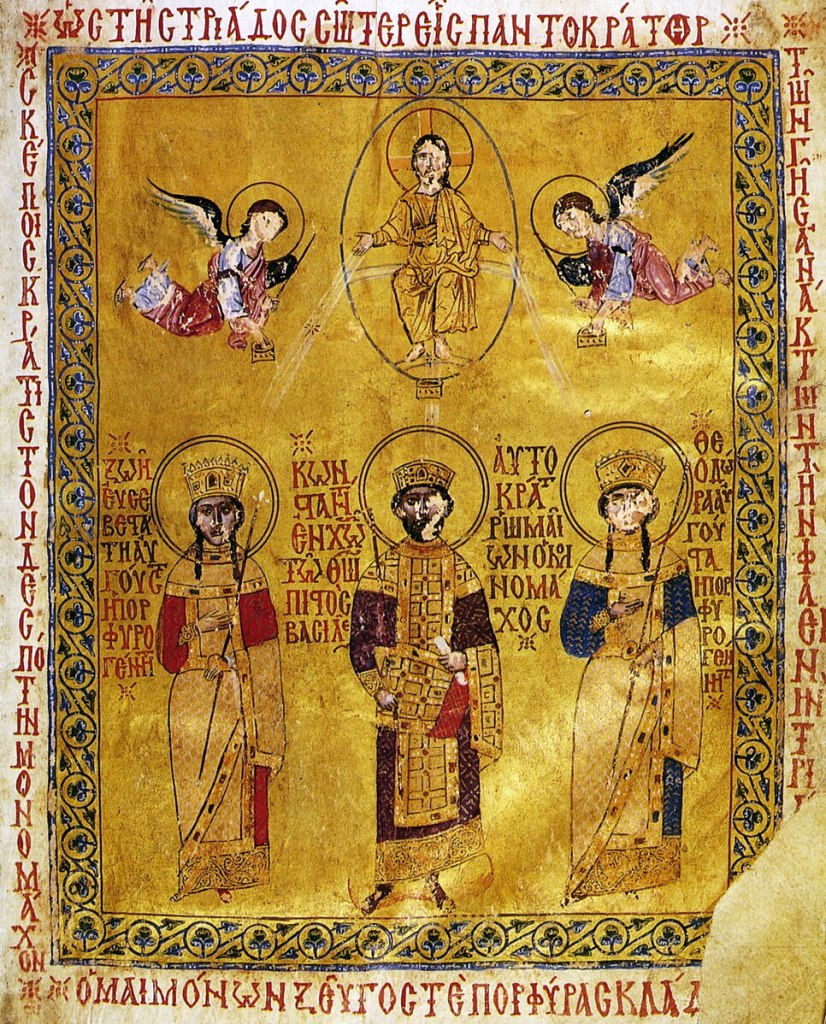
For the next six years, a weird shared balance of power ensued in which whilst Constantine technically ruled, he couldn’t do anything that the public considered a threat or insult to either Zoe or Theodora. Maria Skleraina also had to be less obvious with her influence and status at court. In 1050 Zoe died aged 72 and Theodora made the decision to retire from court, leaving Constantine IX to rule alone although she technically remained Empress. He ruled for five years until his health began to fail. On his death bed, he was persuaded by his inner circle to ignore the rights of Theodora and to pass the throne to the doux (Duke) of the Byzantine Theme of Bulgaria, Nikephoros Proteuon. Evidently they thought that Theodora being in a convent meant she didn’t know what was going on. They were wrong and it turned that Theodora had been aware of their plans all along and before they could implement them she showed up at court (backed by the courtiers who had formed the Pro-Theodora faction when she first became Empress) to vigorously assert her right to rule. Before Constantine and his counsellors had any chance to act, she convened the Senate, and won the support of the imperial guard who proclaimed her “emperor”. This all happened days before Constantine’s death and when he did eventually die, everyone was too fixated on Theodora to really notice. The first thing she did was institute a purge of all the corrupt, ineffectual and traitorous senior government and military officials that had risen to prominence during the reigns of her various brother in laws. Nikephoros Proteuon who Constantine’s advisors had wanted to crown was arrested at Thessaloniki and forcibly tonsured whilst Nikephoros Bryennios whom another part of court had apparently wanted to crown, was dismissed and exiled. Other government ministers she felt had done the empire and the dynasty wrong were banished from court with their estates confiscated. Under Zoe’s tenure being Empress, the nobles had been able to run around unchecked and abuses in government were aplenty. Theodora sought to rectify this problem and for reasons that are completely understandable, trusted very few at court. Military and court offices were filled by officers completely loyal to her including some of her household eunuchs and military commanders such as Isaac Komnenos who she suspected of being against her, were replaced with minor officers that lacked experience. Determined to centralize as much power in her hands as possible, she insisted on presiding in person in the Senate and acted as the supreme judge by hearing appeals civil cases herself. These were rights that as Empress she had, but it offended the more conservative members of court who considered the administration of justice and authority over the Senate the duty of men, not women. Due to her age, many members of court including the patriarch Michael Keroularios advocated that Theodora choose someone to marry and rise them to the position of Emperor, in order to assure a clean succession. She refused to consider marriage, and refused to name an heir to the throne, knowing that doing either of those things would severely limit her power. When she became ill with an intestinal disorder in late August 1056, her advisors met to decide whom they favoured as her successor. They selected Michael Bringas, an aged civil servant and former military finance minister and then presented him to Theodora who by this point was so ill that she was unable to speak but was able to gesture that she accepted. The Patriarch initially refused to accept Bringas due to the fact that Theodora hadn’t vocalised that she was happy with him however he was eventually persuaded to crown Bringas who was crowned as Michael VI. Hours later Theodora died, bringing an end to the Macedonian dynasty’s 189 year rule. She was greatly mourned by the public. Theodora’s life is so frustrating to me because there’s every indication that if she had inherited the throne normally and been allowed to rule as such, she might genuinely have been an exemplary monarch.
Hope you enjoyed this, see you soon!
Alexandra x

 The Monstrous Regiment of Women
I always thought the joint rule of Zoe and Theodora would make a great odd couple sitcom.
LikeLike