When we left Joanna at the end of part 1, things were not, to put it nicely, going swimmingly down in Naples. In fact things were bordering on pretty damn catastrophic, what with threats of civil war, meddling mothers in laws, questionable scheming cousins eager to take the crown off her very pretty head, a husband with ambitions beyond him, papal interventions a plenty, an unprecedented financial calamity, the most horrendous weather conditions possible and a teeny tiny threat of civil war. Sorry to say it doesn’t get any better.
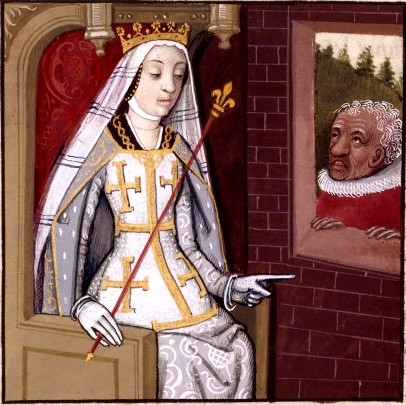
In early 1344 realising her husband and his mother had their fingers in every scheming pot possible, she began trying to cultivate as many allies as people; she also tried to secure the loyalty of the allies she already had. She did this by giving large portions of land to her most trusted supporters, among them Roberto de’ Cabanni. This was a major problem because de’Cabanni was not a random courtier; he was a courtier who she had rumoured to have taken as a lover. Which was causing even more tension with her husband, prompting immense disapproval from courtiers and offending the pope; her relationship with the latter was NOT good (there was some debate between the papacy and Joanna about who owned the land she was giving to her pals). Relations between Joanna and the Pope got particularly bad when she took the oath of fealty to the Pope and agreed to dissolve her regency council replacing it with new palace officials who would govern the provinces. Once she’d pledged fealty however Joanna ignored the orders and refused to pay the yearly tribute to the Holy See. There was then a bunch of negotiating between the Papacy and Joanna; they wanted certain advisors of hers gone whilst she wanted Pope Clement VI to dismiss his legate. Having reconciled with the certain parts of her family that had influence over in France, the French king Philip VI intervened against the legate. The French had a certain importance which led to the Pope agreeing; when he dismissed his legate, he tried to save face by declaring that Joanna had matured under the legate’s authority and that she was know mature enough to rule. In February 1345, the Pope issued a bull, forbidding Joanna’s most trusted advisors—Philippa of Catania and her relatives— from intervening in politics; to placate the Pope and to try and maybe get her husband on her side, she decided to make more of an effort with Andrew. The pair ended up once again sharing a bed and to everyone’s relief/satisifcation she quickly got pregnant. Whilst everyone was celebrating, she covertly tried to do the exact opposite of what the Pope had told her to do and ordered the Seneschal of Provence, to invade Piedmont. It did not go well especially after John II of Montferrat and the Visconti gathered their troops near Chieri and defeated the army in the Battle of Gamenario. As relations between the various parties got tenser and tenser and Joanna became more and more resolute that ignoring the Pope’s demands to crown Andrew asap, involve him in affairs of state and stop giving away royal estates, was the best way forward. Eventually she just ditched her husband. She clearly couldn’t stand Andrew and had come to a point where their marriage was causing her more problems that helping with the myriad of problems she already had. This kickstarted rumours that her and her cousin Louis of Taranto were actually a thing – whether they actually were at this point has never been conclusively proven. The fact there were rumours though was problem enough. With this, the Pope became more clear than ever that he wanted Andrew crowned.
The Pope’s decision made its way back to Naples, and promptly upset just about everyone. And Andrew being a world class jerk did not help matters; he consistently threatened Joanna (who admittedly gave as good as she got and began taunting him back), insulted every just about everyone at court that wasn’t on Team Andrew and made the ludicrously stupid decision to free the Pipinis, three brothers who had been imprisoned for causing chaos across Naples. He freed them and then promptly offered them knighthoods as long as they pledged their fealty to him. To say that Andrew made himself the most unpopular man in Naples would be a vast understatement. That kind of visceral loathing especially in the medieval era really only ends one way. Murder. A group of noble conspirators determined to forestall Andrew’s coronation (and teach him some manners) came up with an entirely mad and completely questionable plan. During a hunting trip at Aversa, Andrew left his room in the middle of the night after a servant came to the door telling him to come quickly to see a courier with important papers he needed to sign; upon leaving his chambers he was attacked by the conspirators. With Joanna on the other side of the palace in her own bedroom, a brutal and very graphically violent struggle ensued; Andrew by all accounts did everything he could to defend himself and allegedly screamed quite horrendously for help which did not come. He was however outnumbered and ended up being strangled with a rope and flung from a window (allegedly the rope was tied to the his genitals which frankly seems unnecessary). His body was apparently left where it fell and was discovered by his nurse who had the corpse taken to a monastery. When the Hungarian knights loyal to his mother arrived she told them everything in Hungarian so none of the native Neapolitans could overhear – they unsurprisingly went straight to Andrew’s mother and brother. Joanna’s involvement on this whole grizzly affair is really really open to debate. There’s every possibility she gave the order and was very specific in how she wanted him to die, however it’s also possible she had absolutely no idea – as I said he’d made himself enemies aplenty. It’s equally as possible she implied to someone she wanted him gone but knew no specifics and was as caught off guard as anyone. We really don’t know. Her general complicity is one big massive question mark. She claimed that she didn’t have a goddamn clue and after the death wrote to her various relatives/allies across Europe expressing her disgust at the murders. She also swore up and down to the Pope that her hands were completely clean of her husband’s blood. I’d be actually impressed if she was involved – there’s absolutely no conclusive evidence so if she was one of the conspirators then they worked really bloody hard to hide all evidence of her complicity. That didn’t stop the rumours from spreading like wildfire and her behaviour in the days afterwards didn’t really help matters; some chroniclers of the period describe Joanna as being unable to cry and refusing to make eye contact with anyone (they read that as guilt) whilst others said that she immediately fled the castle where Andrew had died out of fear that her involvement in his death might be discovered (apparently no one considered that she may have fled because staying in the same place in which your husband was brutally slaughtered a mere 2 days before might be a bit too much emotionally for a pregnant woman under immense stress). It was also claimed by the more pro-Andrew faction that Andrew’s corpse had been abandoned until his nurse had it taken to the monastery – this was seen as highly disrespectful to the dead and a sign of her complicity. The thing is apart from the refusing to look at anyone (which is possible but I don’t know, I wasn’t there), none of the other things are true; there are dated letters with Joanna’s seal on them that prove that she remained at the castle after Andrew’s death, and historical record shows that he was definitely interred the day after his murder so he wasn’t left without an immediate burial. Two major arguments often used to suggest her complicity is that a) she’d spent a number of years openly loathing her husband and they’d openly been at times quite mean to one another, and b) after Andrew had been lured out of his room to face the conspirators, someone had locked the door from the inside so that he couldn’t get back in – as his wife she obviously had the most access to his rooms however I’ve read multiple sources that suggest they were in separate rooms. Not only that but 99% of the people in that castle loathed the guy. She wasn’t the only one eager to see the end of Andrew’s life. A few people really not eager for his death was his family – his mother and brother Louis were in particular FURIOUS and demanded a papal enquiry. The Pope agreed however despite the problems that he had with Joanna, he dragged his feet on the inquiry and pretty much just wanted to forgot the thing and move on. The Hungarian’s were not into the idea nor were they particularly pleased with Joanna’s form of justice. You see, a few days after Andrew’s death, a man named Tommaso Mambriccio was arrested for taking part in the brutal death. The prosecutors in charge of dealing with Mambriccio skipped an actual interrogation in favour of a horrific public torture that involved the removal of his tongue. This was done for one of two reasons either a) the Neapolitan authorities were trying to prove to the Hungarians that Joanna hadn’t been involved and was as eager for justice as them (and got a bit too over-eager) or b) Joanna had been involved and they needed to make sure Mambriccio kept his mouth shut. The thing is everyone assumed it was the latter because of the inescapable act that Mambriccio had clearly not acted alone – someone else was behind the death and Mambriccio the poor fella ended up being collateral damage. There were rumours that two of Joanna’s favourite Philippa the Catanian and Raymond of Compagno were somehow involved in both Andrew’s death and Mambriccio’s leading to accusations that her favourites had killed her husband and she had ordered Mambriccio’s death in order to protect them. Her popularity which had always been sky high hit rock bottom. It was to put it bluntly, an absolute catastrophe. The death of Mambriccio did nothing to calm the Hungarian’s who in January 1346 promptly requested that the Pope hand over Naples to Andrew’s brother Louis; the timing of this request is interesting considering the fact that a month earlier, on Christmas Day 1345 Joanna had given birth to her and Andrew’s son Charles Martel who was later declared Duke of Calabria and Prince of Salerno. For once the Pope made a decent decision and refused to hand over Naples, pledging his support to Joanna. This wasn’t some kind-hearted decision on the Pope’s part; his relationship with Louis had been deteriorating for a while and handing over Naples would have majorly changed the balance of power in Europe. Unhappy with the Pope’s decision, Louis entered into negotiations with Louis of Bavaria and Edward III of England, asking for their assistance. Joanna knew what this meant and immediately “ordered Naples to prepare for war and the defence of the Kingdom, ordering all castellans and nobles to muster, and issuing edicts forcing all unemployed mercenaries to quit the kingdom, so they could not be hired by by outside powers to cause trouble. She reached out for help to Venice, Hungary’s traditional enemy in the region. Joanna also sold Avignon to the Pope in order to raise desperately needed funds and exacted a war levy of Provence” [1]. Clearly our girl was determined to fight. And boy did she have to. Louis was causing absolute CHAOS everywhere and unfortunately for Joanna, everything was going his way. If you remember Joanna’s allies were the French – well the French were not exactly in a good place; in August 1346 they were crushed by the English at the Battle of Crecy. John of Luxembourg King of Bohemia died whilst Charles the leader of the pro-French faction in the Holy Roman Empire was severely wounded. This was horrible for the French and really horrible for Joanna who desperately needed a strong France as an ally. By the end of 1346 the city of Apulia was rebelling against her. Joanna for reasons unknown to me, then decided to announce to the world that she was planning on marrying her cousin Louis of Taranto. To say that the engagement announcement annoyed everyone is an understatement; the Hungarians were fuming as was Louis’ elder brother Robert who as the older brother technically had more of a right to marry Joanna than Louis – Joanna and Louis’ union however did have the blessing of his mother Catherine of Valois due to the fact that Louis was her favourite son. Although it could be argued that marrying Louis was questionable, he was kind of her only choice – not only was he a seasoned warrior but he also had a deep understanding of Neapolitan politics and she could not turn to the Durazzo side of the family. Joanna claimed she was marrying him “based on the advice of the prelates and barons who were her counsellors” [2]. No-one believed her including the Pope; after all there had long been rumours about the nature of Louis and Joanna’s relationship – there is some possibility the marriage was both a political and personal decision. After Joanna stated her intention to marry him, his brother Robert and their cousin Charles of Durazzo (who was also pissed) joined together despite years of tension to march against Louis and Joanna. Robert after all had been banking on the possibility that if anything happened to Andrew, he’d get the chance to marry Joanna and be King; similarly if Joanna was dethroned the next in line (after her son) was her sister Maria who just happened to be Charles’ wife. Robert and Charles claimed that they were not going against Joanna because of the marriage, noooo they claimed they were doing it out of some deep seated quest for justice, claiming that she and Louis were protecting her favourites who had murdered her husband. It’s all a bit laughable because the two men had not been particularly upset when Andrew had died and in the six months since had not shown any great desire to find his killers; as Nancy Goldstone writes “the fact neither man had thought to pursue his killers before Joanna announced she was marrying Louis was conveniently forgotten” [3]. Some of Joanna’s courtiers, advisors and close servants were apprehended, tortured and then executed for their supposed involvement in Andrew’s death; this included her Seneschal Raymond of Catania who in order to calm the tensions in the city had issued a decree banning the carrying of weapons in public. This backfired because with no weapons to defend himself he was arrested easily. His torture was done publicly both in the main public square “to satisfy the bloodlust of the mob” [4] and on the balcony of Robert’s castle so that his agony & confessions were “comprehensible to the crowds below” [5]. The problem with torture is that to stop the agony, anyone will say anything and boy did Raymond; he sang like a canary and named a number of “high level conspirators: the marshal of the realm, the Count of Terlizzi, the grand Seneschal Robert of Cabanas; Nicholas of Melizzano, a member of the royal household (who actually seems to have participated in the killing); Joanna’s nurse Philippa of Catania; Philippa’s granddaughter Sancia, Charles of Artois and his son Bertrand, Tomasso Mambirccio’s brother and sister and a number of others associated with Joanna’s circle” [6]. So basically everyone that Joanna relied on. This led to an absolute frenzy which culminated in a mob attacking the Castel Nuovo where they mistakenly thought Joanna was. One chronicle of the period claimed “Guelphic banners identifying themselves as warriors for the church, shouted “Death to the Traitors”, “Death to the Whore of a queen” and “Surrender the Traitors” [7]. The evidence for this is sparse and there’s only one contemporary chronicle that references it. Some of the people Raymond had named under torture were immediately arrested however the Artois’ managed to escape and seek protection with Catherine of Valois. What followed was really quite horrendous – those suspected of involvement were tortured by Hugo the Count of Avellino (a long-time pain in Joanna’s behind) and then by Charles of Durazzo. Joanna sent emissaries who argued against immediately executing them; in this she was successful however this meant they ended up languishing in a grim prison cell for months. This all led to a lil bit of Neapolitan civil war – Robert declared himself her fiancée and moved in with her despite her protestations. He then became issuing royal proclamations left, right and centre and told the Pope to go ahead with the dispensation for them to marry. Joanna objected and sent word to the Pope to absolutely not do that claiming that under no condition would she marry Robert. On April 26th Robert named himself Captain General of the Kingdom however Joanna made a counter move by assigning Louis control of the bulk of the battalions attached to the various royal castles. The thing is the whole situation, proved why Joanna was marrying the guy. Louis did an exceptional job and was successful in driving his brother’s forces back. A small victory that unfortunately did not last because just as he reached Naples, it became known that the Hungarians planned to invade and all hell broke loose – part of the reason that the Hungarians were now determined to invade was, you guessed it the English! (It’s always the bloody English). After the English had devastated the French at the Battle of Crecy and gained the upper hand in the Hundred Years War, the French were now struggling to defend themselves and thus of absolutely no help to Joanna whilst Edward III of England had begun encouraging Louis to invade Naples. This meant Joanna was then forced to find new friends; she made a pact with the Kingdom of Sicily to prevent them from invading at the same time (there’s only so many invading armies one can deal with). She also tried to forge an alliance with Hungary’s traditional enemy Venice (Venice & Hungary HATED each other), sold Avignon to the Pope in order to raise funds and made the difficult decision to enforce a war levy on the nobles of Provence. The reason I say difficult decision is that Joanna wasn’t exactly super popular at his point and raising taxes on nobles (who lets be honest have not exactly demonstrated throughout history an unbreakable loyalty to their king/queen or a willingness to do exactly as their monarch, especially a female one says) was a risky move that could have caused all sorts of extra very inconvenient complications [8]. She also attempted to keep the many members of her nightmare family and court under control; she tried to get her cousin Robert of Taranto and her cousin/brother in law Charles of Durazzo (who had been colluding with the Hungarians) back on her side by a) betrothing her young son Charles Martel to Charles of Durazzo’s daughter (and thus her niece) Jeanne (this would of course mean the Durazzo’s might not be on the throne in the current generation but they would in the next) and b) persuading the Pope to grant a dispensation for Robert of Taranto to marry the exceptionally wealthy Marie of Bourbon who was the widow of the late King of Cyprus and a member of one of the most important families in France. This was in theory a stroke of genius – with Marie’s money, Robert could now focus his attention on gaining control of the lands he had inherited in the east (he had inherited the title of emperor of Constantinople however without money or an army he wasn’t able to actually take control of what was his). This meant his attention wasn’t focused on making Joanna’s life hell [9]. Now if you read back, you’ll notice I said in theory, this was a stroke of genius. Because you see things that seem like a good idea, sometimes then end badly in practise. Carry on reading and you’ll see what I mean.
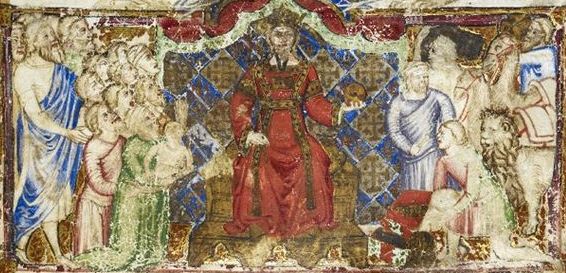
On 22nd August 1347 Joanna and Louis married in private without seeking the necessary Papal dispensation. The marriage would turn out to be the death knell for her popularity and the people of Naples quickly came to the assumption that she ordered Andrew’s death in order to marry Louis. They were further enraged by her decision to name Louis Joint-Protector and Defender of the Kingdom (1 May 1347), jointly with their cousin Charles of Durazzo. Louis was also named Vicar-General of the Naples and coins began being minted that contained were engraved with the likeness of both Joanna and Louis. Out of her four husbands Louis would end up being the only one to be granted the significant monarchical privilege of appearing on a coin (see here). Her first husband obviously died before he was crowned where husbands 3 & 4 (who we have yet to meet) weren’t included on coins owing to well crafted prenuptial agreements Joanna had them sign [10]. One of the most interesting things about Joanna and Louis’ coins (some of which still exist) is that both Joanna and Louis are referred to as Rex (King) [11]. Typically female monarchs who make the distinction of refering to themselves in masculine terms would not raise their husband to the same title. Joanna however did. The Pope meanwhile was doing everything he could to calm tensions. With Naples in an uproar, Andrew’s brother, took this opportunity to go full steam ahead on his plans for annexation. The thing is he had actually been engaging in military shenanigans against Naples for quite some time; as early as April the Hungarians had entered Aquila, by May they had besieged Sulmona and around the time of her marriage to Louis in August, several Hungarian lords, led by Nicolas Vásári, the Bishop of Nyitra had entered Naples with troops [12]. The main Hungarian army had not arrived nor had the Hungarian King. Charles of Durazzo was sent first to Sulmona and then to Abruzzi to deal with the first Hungarian troops; the news he brought back was fairly grim. To make matters worse in November of that year, Joanna’s former brother in law Louis of Hungary left Visegrad to lead his troops himself. Louis made his grand march on Joanna’s kingdom on All Saints Days – it’s not clear how many troops he had exactly, the Hungarian forces were made up of a mish mash of Hungarian troops, mercenaries, allied soldiers and Hungarian warlords; “between the Hungarian troops and hired mercenaries who joined during the march, it appears that Louis had 5000-6000 troops of his own – and possibly an equal number of mercenaries and allied Lombard contingents” [13]. Now all the grand men of Joanna’s realm turned out to be both utterly useless and completely traitorous because Louis’ march through Naples was fairly uncontested; in Modena, Bologna and Forli lords and troops pledged their support whilst on the 11th of September in Verona he was visited by envoys from Florence (who were claiming neutrality) [14]. Things were not looking good for Team Naples and in December it was decided it was finally time to take on the Hungarians. Joanna’s cousin-husband Louis of Taranto and her cousins/brother in laws Robert of Taranto and Charles of Durazzo gathered their army in Capua – this particular location was chosen due to the fact it lay at a bend of River Volturno – the Hungarians vastly outnumbered the Naples troops however the strategic location of Capua made it easier for Joanna’s army to take advantage of any weakness shown by the Hungarians [15]. Where was Joanna in all of this you may ask? Well homegirl was at home in Naples, already preggers despite having been married to Louis for all but 10 minutes. She did however make some contributions to the war effort, pardoning large numbers of bandits in exchange for their assistance. It unfortunately for Joanna, became very clear very quickly that this was absolutely not going to go Joanna’s way. Not only were the Neapolitan army majorly outnumbered but the army was made up of Durazzo and Taranto troops – the Durazzo’s and Taranto’s had been at each others throats for decades so everyone was deeply unhappy at having to fight alongside one another. It was a mess quite honestly. On January 11th 1438 Louis of Hungary conquered the pivotal city of Benevento. When word reached the Neapolitan forces of this embarrassing loss, the leaders of the army Charles of Durazzo, Robert of Taranto and Domenico da Gravina held a lil conference and decided to surrender to the Hungarians and do homage, hoping that he’d take mercy on them and let them into his good graces (apparently forgetting that he suspected they were involved in his brothers murder or at the bare minimum had covered up for Joanna aka the person he ultimately blamed for Andrew’s death) [16]. I have such a visceral hatred for Charles and Robert I can’t even tell you. Below is how I feel towards Charles in particular.

Louis for his part did everything he could to convince his brother/cousins to stay and fight for Joanna but they ignored him and returned to Naples with all the Taranto and Durazzo troops in tow leaving Louis with a very small army with which to fight. With the Hungarians on their way, a pitiful excuse of an army left and her good for nothing cousins ready to bow to the enemy, Joanna was convinced by her advisors to flee, with them coming to the conclusion she stood a greater chance of winning the war overall if she went to Provence (which she ruled), raised an army there and sought the assistance of both the Pope at Avignon and her husband’s cousin the King of France, with the intention of maybe one day returning to reclaim her kingdom. There was also the fact that she knew that Louis of Hungary had absolutely no intentions of sparing her life if he got his hands on her. She did however put provisions in place for the sake of her kingdom, appointing a committee of nobles to rule the realm in her absence [17]. On the 15th January she left Naples on two galleys—owned by Jacques de Gaubert who took her to Provence. Accompanying her was her old lover Enrico Caracciolo whilst her husband, still at Capua, followed her the next day when he caught wind of her plans. One person who did not accompany her to Provence was her baby son Charles Martel. Leaving behind her son was not what Joanna, who by all accounts absolutely adored him, wanted to do but she had no choice. Immediately after her sons birth her former mother in law Elizabeth and brother in law Louis of Hungary had started demanding custody of her and Andrew’s son and Joanna had steadfastly refused despite the Hungarian’s never stream of threats and demands. As a compromise she had agreed to appoint Andrew’s governess Isabelle to watch over the child but Isabelle had not let him leave her side. You may wonder then why she agreed to leave him behind. There were three reasons 1) it would have been near impossible to have snuck him out the palace without Isabelle noticing and the minute Isabelle did, there was no doubt she’d get word to the Hungarians that Joanna was fleeing and they’d stop her which would ultimately culminate in her demise, 2) the child was literally a baby and a very uncertain voyage on rough seas in the dead of night is maybe too much of a risk for an infant and 3) she knew without a shadow of a doubt that the Hungarians wouldn’t harm her son – not only had they been demanding custody of him since the day he was born but Louis of Hungary had made it clear that getting her son away from her was one of his key reasons for invading AND if the Hungarians intended to rule in Naples, having custody of the heir to the throne was certainly a bonus. Keeping little Charles safe was both politically and personally beneficial to the Hungarians [18].
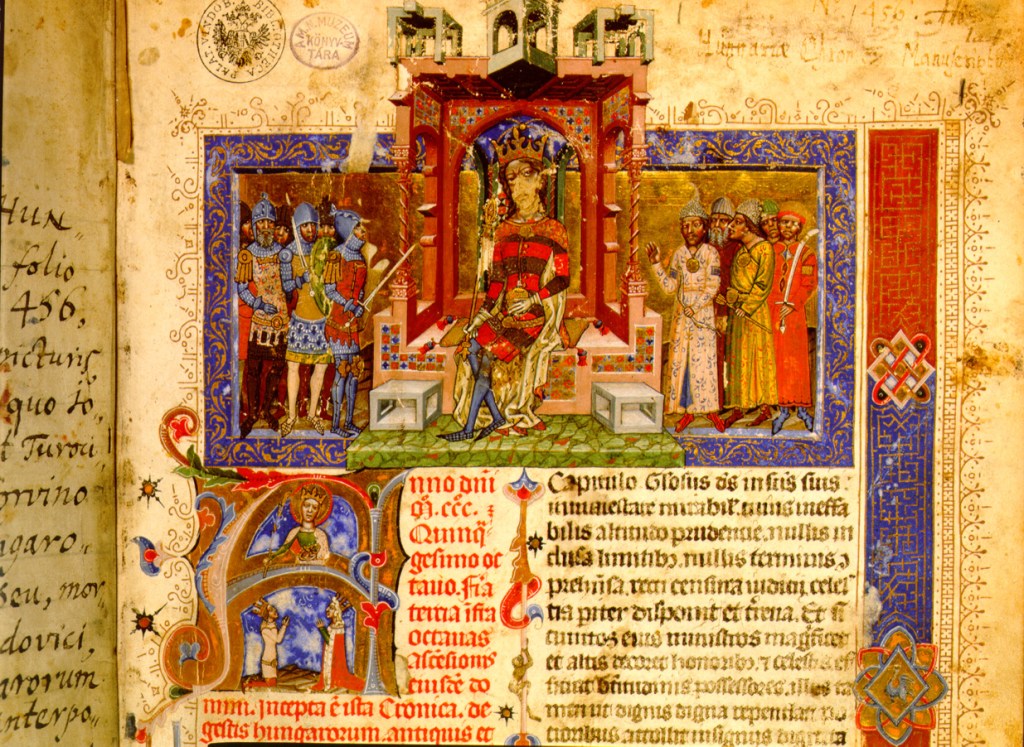
Joanna was long gone by the time Louis of Hungary caught wind by of her departure. He then began marching towards Naples, taking the cities of Capua and Aversa first. As Joanna had predicted, the first thing Louis did was demand custody of her son. On January 19th Joanna’s back stabbing cousins/brother in laws Charles and Robert entered Aversa to beg and plead for Louis’ forgiveness and pledge allegiance. The first time I read about this, I found it interesting that the two men pledged allegiance to Louis in the same place that his brother was murdered (a fact that Nancy Goldstone agrees with). They were seemingly confident that the man would be cool with them despite the fact he was willing to invade an entire country in revenge for his brother’s death. A risky move. Initially their risk seemed to have paid off and Louis welcomed them magnanimously even throwing an over the top banquet in their honour. Things however went downhill fast. As one chronicler wrote, “the king greeted the princes graciously, left them in the great hall of the palace and went into his room with his advisors. After careful consideration the counsel decided the princes should be arrested after the meal [19]. It’s all very Game of Thrones Red Wedding. Charles and Robert eating happily in the grand hall whilst Louis all but signs their death warrant next door. At the end of the meal, Louis gave what can only be described as a pretty spectacular speech in which he lambasted Charles and Robert’s involvement in preventing his brother from being crowned (a minor issue, I think), complimented them for seeking justice against his brother’s murderers but then pointed out that they only did so to increase their own influence, furiously condemned them for leading an army against him despite their promises of loyalty a few months before and made a prediction of what their future plans would be if he didn’t arrest them – “you would then have remained the sole power in the country and you would then have plotted our death” [20]. This seems fairly accurate so I’ll give credit where credit’s due. All the Durazzo’s and Taranto’s were then arrested (this included Robert of Taranto, Philip of Taranto, Louis of Durazzo and Philip of Durazzo) and thrown in jail. Charles of Durazzo widely considered the biggest villain in the situation, was hauled in front of a Hungarian military tribunal who promptly held a sham trial which found him guilty. Louis of Hungary, ever the showman, then asked Charles to tell them specifically where Andrew had died. Charles at this point had very little to lose so took Louis to the very terrace where Andrew had been slaughtered. What followed next was dramatic to say the least; “Charles of Durazzo was then beheaded on the spot, and the bloody trunk of his body thrown over the balcony railings and into the garden below, there to lie as Andrew’s corpse had lain on that fateful September night some two years before” [21]. Charles of Durazzo’s death led to two things – 1) a night of immense and brutal violence as noted by Domenico da Gravina and 2) the end of the engagement between his daughter and Joanna and Andrew’s son Charles Martel. Upon Charles’ death, soldiers, partisans and servants loyal to the Durazzo and Taranto households were hunted down and murdered. The wives of the five men, including Joanna’s own sister were also targeted however both Maria and Robert of Taranto’s wife Marie of Bourbon sought refuge in churches where they were hidden before loyal Neapolitans sneaked them out the city – Maria fled firstly to Tuscany and then boarded a ship to take her and her children to Joanna in Provence whilst Marie of Bourbon had allies in Florence who offered her protection [22]. With Aversa under control, Louis of Hungary made his way into Naples where he was initially greeted relatively well however within about 20 seconds of arriving in the city, the Neapolitans welcome became less enthusiastic. For starters Louis spat on traditional Neapolitan traditions (i.e entering the city under a cloth canopy) and instead “entered the town mounted and in full armour bearing a sword” [23]. This seemed a tad aggressive, as did his first three official acts as King. Firstly he divided up “the palaces, properties and possessions of the House of Taranto and Durazzo and dispensed these riches to himself and his generals” [24], secondly he “threatened the populace with a general sack if the citizenry did not raise a exorbitant sum of taxes to their new sovereign” and finally he then “organized government along lines favouring the Hungarians and those Italians who had aided his campaign” [25]. These acts did not make him overwhelmingly popular nor did the fact that he made the decision to send his nephew aka Joanna’s son aka the heir to the damn throne, away from Naples, sending him to to Visegrad the capital of Hungary. This decision was made allegedly to keep the little toddler safe and anyway from any Neapolitan intrigues. I suppose you could make the argument that people still loyal to Joanna could potentially get to him in Naples whereas he was completely cut off from Joanna and the Kingdom of Naples if he were kept in Hungary. Sending him to Hungary proved to be a horrendous mistake and little Charles Martel allegedly struggled with both the long arduous journey from Southern Italy to Eastern Europe AND the bitterly cold climate of Visegrad. Just weeks after he arrived in Hungary, the little boy died.
Where was Joanna during all these shenanigans you ask? Well after arriving in Provence, she hot-footed it to Marseille where she knew she maintained some degree of popularity, so much so that the people of Marseille actually referred to her as “the Mistress of Marseille”. The problem was that Marseille was not actually the main seat of power in the region – that honour belonged to Aix-en-Provence where Joanna was less popular. Her lack of popularity actually wasn’t solely her fault – sure they had been pretty pissed about the tax levy’s she had put in place to fund her less than successful war but as Nancy Goldstone notes, a lot of the issues the nobles of Aix-en-Provence had with its Neapolitan rulers actually stemmed from her grandfather’s reign and not of her own making. Adding to her crappy luck was the fact that one of the nobles in question was the Dauphin of Vienne who it just so happened, was her late husband Andrew’s cousin. Shortly after she arrived the dauphin ordered the arrests of her chamberlain and a number of others within her retinue however he and his agents were very careful not to arrest or harm her. This suggested to Joanna that whilst the Dauphin himself felt personally aggrieved, the anger towards her hadn’t extended to all of the nobles. After all if every member of the high nobility had defected to the side of the Hungarians, then they would have just arrested her and handed over to Louis. The fact the dauphin had explicitly not arrested her confirmed that whilst the nobles of Provence were a bit grumpy with her, they were still ultimately loyal and would not have let the dauphin get away with arresting with. To get the nobles back on side, she kicked off a charm offensive and began neogiations with the various administrators in the region. She listened carefully, apologised profusely and was kind and graceful and warm which won over many. She won them over further when on February 19th she “swore by solemn oath to appoint only persons native to Provence to the the government and this gesture was immediately reciprocated by an oath of fealty from the local authorities and regional aristocracy” [26]. In other words Provence was loyal to their Queen. This is the thing I find so frustrating about Joanna is that she wasn’t a bad queen nor a poor politicians. Whilst yes admittedly some of her decisions were poor, there’s numerous instances including how she won over the nobles in Provence, that demonstrate that the girl had real political instincts and talent. Unfortunately the questionable decisions she made, combined with the shitty power hungry men around her, a horrible set of circumstances and the patriarchal society of the time all went against her. Now, Joanna could very easily have remained in Provence ruling as it’s Queen for the rest of her life in relative peace however she was determined to a) get her throne in Naples back and b) get her son. She was not willing to give up either and so thus began the next phase of her life, also known as the “Get my Throne Back Era”.
We’ll see how that plays out in Part III. See you all soon, hope you’ve enjoyed this!
Alexandra x
References:
[1] Russ Mitchell & Annamaria Kovács, “A Medieval World War: The Hungarian Invasion of Italy, 1348-1350”, in Medieval Warfare, Vol 3, No.4, (2013), p. 44.
[2] Nancy Goldstone, “The Lady Queen, The Notorious Reign of Joanna I Queen of Naples, Jerusalem and Sicily”, (2009, Walker & Company, New York), p. 123.
[3] Nancy Goldstone, “The Lady Queen, The Notorious Reign of Joanna I Queen of Naples, Jerusalem and Sicily”, (2009, Walker & Company, New York), p. 124.
[4] Nancy Goldstone, “The Lady Queen, The Notorious Reign of Joanna I Queen of Naples, Jerusalem and Sicily”, (2009, Walker & Company, New York), p. 126.
[5] Nancy Goldstone, “The Lady Queen, The Notorious Reign of Joanna I Queen of Naples, Jerusalem and Sicily”, (2009, Walker & Company, New York), p. 126.
[6] Nancy Goldstone, “The Lady Queen, The Notorious Reign of Joanna I Queen of Naples, Jerusalem and Sicily”, (2009, Walker & Company, New York), p. 126.
[7] Nancy Goldstone, “The Lady Queen, The Notorious Reign of Joanna I Queen of Naples, Jerusalem and Sicily”, (2009, Walker & Company, New York), p. 126.
[8] Russ Mitchell & Annamaria Kovács, “A Medieval World War: The Hungarian Invasion of Italy, 1348-1350”, in Medieval Warfare, Vol 3, No.4, (2013), p. 44.
[9] Nancy Goldstone, “The Lady Queen, The Notorious Reign of Joanna I Queen of Naples, Jerusalem and Sicily”, (2009, Walker & Company, New York), p. 142.
[10] William Monter, “Gendered Sovereignty: Numismatics & Female Monarchs in Europe 1300-1800”, Journal of Interdisciplinary History, Vol. 41, No. 4, (Spring 2011), p. 540
[11] William Monter, “Gendered Sovereignty: Numismatics & Female Monarchs in Europe 1300-1800”, Journal of Interdisciplinary History, Vol. 41, No. 4, (Spring 2011), p. 541.
[12] Russ Mitchell & Annamaria Kovács, “A Medieval World War: The Hungarian Invasion of Italy, 1348-1350”, in Medieval Warfare, Vol 3, No.4, (2013), p. 45.
[13] [8] Russ Mitchell & Annamaria Kovács, “A Medieval World War: The Hungarian Invasion of Italy, 1348-1350”, in Medieval Warfare, Vol 3, No.4, (2013), p. 46.
[14] Russ Mitchell & Annamaria Kovács, “A Medieval World War: The Hungarian Invasion of Italy, 1348-1350”, in Medieval Warfare, Vol 3, No.4, (2013), p. 46.
[15] Russ Mitchell & Annamaria Kovács, “A Medieval World War: The Hungarian Invasion of Italy, 1348-1350”, in Medieval Warfare, Vol 3, No.4, (2013), p. 47.
[16] Nancy Goldstone, “The Lady Queen, The Notorious Reign of Joanna I Queen of Naples, Jerusalem and Sicily”, (2009, Walker & Company, New York), p. 146.
[17] Nancy Goldstone, “The Lady Queen, The Notorious Reign of Joanna I Queen of Naples, Jerusalem and Sicily”, (2009, Walker & Company, New York), p. 146.
[18] Nancy Goldstone, “The Lady Queen, The Notorious Reign of Joanna I Queen of Naples, Jerusalem and Sicily”, (2009, Walker & Company, New York), p. 147.
[19] Nancy Goldstone, “The Lady Queen, The Notorious Reign of Joanna I Queen of Naples, Jerusalem and Sicily”, (2009, Walker & Company, New York), p. 150.
[20] Nancy Goldstone, “The Lady Queen, The Notorious Reign of Joanna I Queen of Naples, Jerusalem and Sicily”, (2009, Walker & Company, New York), p. 150.
[21] Nancy Goldstone, “The Lady Queen, The Notorious Reign of Joanna I Queen of Naples, Jerusalem and Sicily”, (2009, Walker & Company, New York), p. 151.
[22] Nancy Goldstone, “The Lady Queen, The Notorious Reign of Joanna I Queen of Naples, Jerusalem and Sicily”, (2009, Walker & Company, New York), p. 152.
[23] Russ Mitchell & Annamaria Kovács, “A Medieval World War: The Hungarian Invasion of Italy, 1348-1350”, in Medieval Warfare, Vol 3, No.4, (2013), p. 47.
[24] Nancy Goldstone, “The Lady Queen, The Notorious Reign of Joanna I Queen of Naples, Jerusalem and Sicily”, (2009, Walker & Company, New York), p. 151.
[25] Russ Mitchell & Annamaria Kovács, “A Medieval World War: The Hungarian Invasion of Italy, 1348-1350”, in Medieval Warfare, Vol 3, No.4, (2013), p. 47.
[26] [24] Nancy Goldstone, “The Lady Queen, The Notorious Reign of Joanna I Queen of Naples, Jerusalem and Sicily”, (2009, Walker & Company, New York), p. 155.
Other Bibliography
Theresa Earenfight, “Queenship in Medieval Europe”, (London, Palgrave Macmillan, 2013).
“Medieval Elite Women and the Exercise of Power 1300-1400”, ed by Heather J Tanner, (London, Palgrave Macmilian, 2019).

 The Monstrous Regiment of Women
