As I recently wrote on my Instagram account (see here & follow if you haven’t already!) I was very sick this summer to the point that I spent several weeks in intensive care. This was one admission in a series of quite serious admissions that are a result of my Cystic Fibrosis; I can’t quite remember if I’ve discussed my illness on here. I believed I mentioned it in my introductory post but I haven’t mentioned it further because this blog isn’t about CF, it’s about history and the amazing women that have changed the world, it’s about my love of the past and it’s an outlet for me to share my passion with all of you. CF however has had, an inarguable effect on the blog. It’s the reason I’ve been posting on the blog far less than I originally planned/would want and I’ll be honest in recent months I have considered whether to stop. As much as I love researching and writing the blog, I’m at a point in my life where my health has significantly declined, so much so that I was put on the transplant list earlier this year as my lungs have well and truly given up on me! Everything feels very serious and a little scary and so I debated whether the blog was just an added pressure and stress that I seriously do not need. Every time I failed to upload a post, or felt too ill to finish a post or research or missed a date that I had put down in my diary as a day I would upload a post, I felt completely disheartened and super disappointed in myself and just downright shitty. However I also considered the fact that I do so love this blog and the instagram and whilst I don’t upload as much as I like, it’s an absolute pleasure when I do. So I intend to continue, to carry on, as long as my crappy lungs and dodgy pancreas allow. I intend to carry on because I love writing and I love history and where better to do all that, then here. With that out the way, I mentioned on the Instagram that really the only way to get through 8 weeks in hospital is a ton of good books. I shared three on Instagram however I’ve continued reading since my discharge and have had the pleasure of reading a few old favourites I haven’t explored in a while. I thought I would share that with you today in a much belated Book of the Month post. I do actually have another post planned for next week that I’ve nearly finished and I look forward to you all reading!
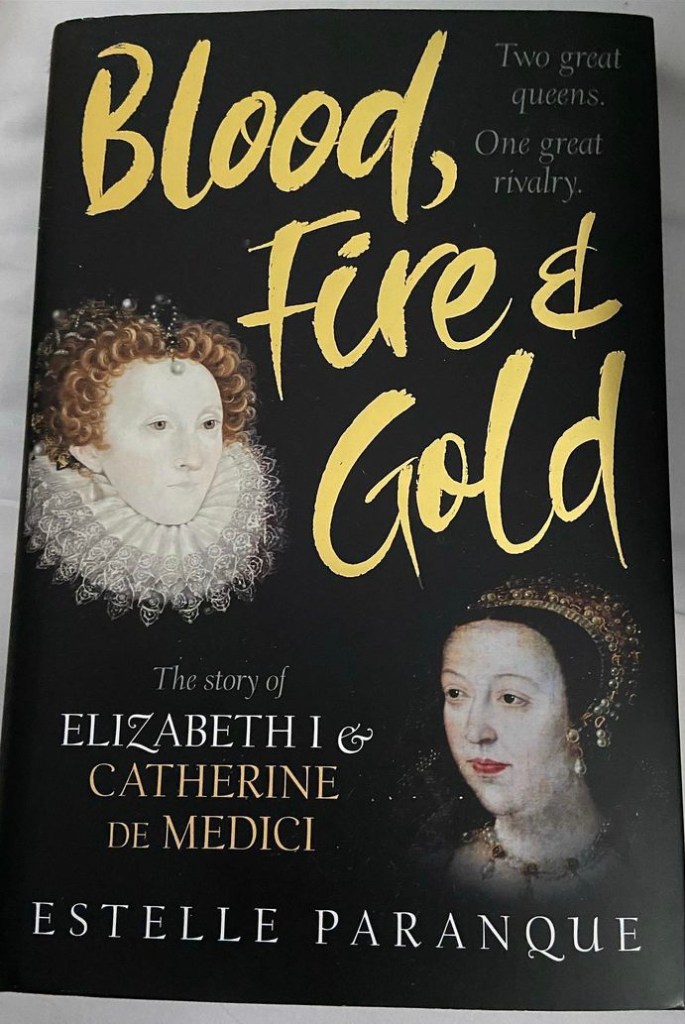
I cannot tell you how excited I was for this book when I pre-ordered it months ago; I mean Elizabeth I & Catherine de Medici are two of my favourite historical women and Estelle Paranque is a historian I really enjoy so it pretty much seemed like a book dream come true. When it arrived a few weeks ago, I began reading immediately and although I was very excited, I was also slightly nervous that it would disappoint. Did it? I hear you ask. No, it absolutely did not! I’m thrilled to say I loved this book and would absolutely recommend it to anyone with an interest in either woman. The book is written in chronological order with each chapter split between Catherine and Elizabeth and even if you don’t necessarily know much about one or either of them, the similarities between them become clear. It’s wonderfully written; clear and concise and the use of primary sources, of which there is an abundance, is just SO good. Ambassadors correspondences from that period as well as Elizabeth and Catherine’s own correspondences have been pretty well preserved and Estelle takes full advantage that, using them to weave a really interesting narrative. At times the book feels more like a novel which I actually think to some extend works in it’s favour, as readers without an academic history background will enjoy it as much as historians well acquainted with the source material. I know Estelle is a great admirer of both women and you can tell from her writing; unlike many writers who have a tendency to vilify Catherine, in particular, she doesn’t do that and her nuanced portrayal of Catherine, I think does her great justice. One thing I do really love is that Estelle never never degrades Elizabeth in order to uplift Catherine and vice versa; both women had strengths and flaws and the book recognises that without pitting them against each other in a way that feels unnecessary. Overall I really enjoyed this book; it was absolutely worth the wait and will definitely go on my recommendations list to friends and family.

I don’t know what it is with me and dysfunctional historical marriages but I love them. As far as I’m concerned they’re the best historical marriages. And this one was more dysfunctional than most. To start off my mini-review it goes without saying that this book is extensive; it’s absolutely huge which I’m aware may put some people off, and certainly there are details/sections of this book that I don’t think are particularly necessary but I would still recommend it if your wanting to know more about either side of this disastrous marriage. Now this book I wouldn’t say is the easiest read and there are certainly sections where if you haven’t got an already detailed understanding of the period and the players, you might get a bit lost. The amount of sources are impressive (one of the reasons this period is fab for historians is that so much has been saved compared to earlier periods) and in some sections this book is very well written (although in others, it feels a little convoluted). One thing I like about this book is that it gives Josephine a fair shake; most biographies of Napoleon are written by men and unfortunately male historians tend to be less than forgiving and highly misogynistic to Josephine (I will scream into the abyss for the rest of my life that there is no evidence she was as unfaithful as we’re often lead to believe; the two buttheads that pushed that narrative were Napoleon’s brothers and they had agendas!!). Evangeline Bruce not only gives Josephine a fair shake but actually manages to portrays her as a complex human being with strengths and flaws; I don’t think Bruce needs to repeat as many slanders about Josephine as she does – at times it feels a little gossipy but I suppose it does demonstrate how brutal the rumour mill was about her. Interestingly enough out of the two, it’s Napoleon, I think that gets the harsher treatment, which is a rarity in historical literature.

If you’ve read this blog or had a look at my instagram or know pretty much anything about me, then you know that there are very few male historical figures that I have a profound interest in; I mean let’s be honest history is basically just a shit show of men making stupid decisions and causing chaos/agony to the rest of the world. There are however a couple of exceptions; Francis I King of France & Suleyman I Sultan of the Ottoman Empire (aka the best rulers of the 15th century, f*** Henry VIII & Charles V), Akenhaten (literally changed the entire religion of his empire in one of the biggest religious shifts in history only for his successors to pretend it didn’t happen after he died?? also Nefertiti was his wife so well done him), Napoleon (terrible person, dumb decision maker who should never have divorced his first wife or invaded Russia & man who went from insignificant general to emperor controlling Europe in a decade), Mark Antony (chaotic legend) and Henry II King of England, Robert Dudley & John of Gaunt Duke of Lancaster (three man sluts with excellent taste in women; hello Eleanor of Aquitaine, Elizabeth I & Katherine Swynford). Other than those guys, my interests evidently lie with the women of history, which is why it might surprise you to see a biography of a man. However as I just noted I love John of Gaunt. I do. I admit it. I find him so interesting; from his wealth and influence, his role as de facto but not quite regent for his nephew Richard II, his apparent unpopularity because of said wealth and influence, all the way to his love life which a) was blamed for a rebellion against the crown and b) caused chaos several generations later when a civil war was fought between four candidates for the throne (Edward IV, Henry VI, Richard III & Henry VII) all of whom were his descendants. John of Gaunt was no king and very few people without an in depth knowledge of history or Shakespeare would know who he is, and yet he’s one of the most pivotal figures in English history. I’ve read lots of books where he’s mentioned or briefly talked about, but there are few biographies that focus solely on this. This one by Helen Carr, I have to say I really enjoyed. It’s an easy read, concise and not overtly academic to the point that casual readers of history might struggle; admittedly at times it read more like a chronology than a deep analytical insight into the man himself, but it’s well researched and Carr uses the primary sources very well. There were certain points throughout the book where I would have liked her to expand on certain subjects or individuals; would I have liked a little more Katherine Swynford for example? Yes absolutely, but I can recognise that this book is not about their relationship. It’s about him and his life as a whole. At the end of the day the book does what it intends to do.

Speaking of Katherine Swynford, here’s a book about the lady herself! I know there may be some historians that may wince at the fact this is a Alison Weir book (her work hasn’t always been the most accurate; I mean I’ve read something she wrote in which she claimed as fact that Henry VIII fathered 15 children despite the fact that’s just not true) but there isn’t a great number of biographies about Swynford and with good reason; unlike Gaunt’s other wives she didn’t come from royalty or nobility and it wasn’t until the world became aware of their inadvisable, some might say sinful relationship, that she was afforded any degree of importance. That means that there’s an awful lot about her that is unknown; from the lineage of her father to the identity of her mother to the precise dates of her first marriage and birth of her children; hell we’re not even 100% sure how many children she had from her first marriage. It’s all very unknown. Weir I think does a pretty good job of presenting various possibilities about the unknown parts of Katherine; the section at the beginning of the book which tries to make sense of her family background, I think is pretty well done and the options she presents are all very plausible. As a historian there’s a balancing act to be done when you have a subject but very little primary sources about said subject; you can make educated guesses but you have to be careful not to go too far and start making assumptions. Weir does that occasionally with Katherine but not too often that it’s terribly off-putting or ruins the book in its entirety. Some assumptions about Katherine’s character for example are made, but they’re educated guesses rather than ludicrous fantasies and I think Weir does a pretty good job of weeding through the limited primary sources to get an idea about Katherine herself. As expected there’s very few primary sources about Katherine but Weir uses the primary sources at her disposal well, and like Helen Carr’s John of Gaunt biography, it’s well written, concise and an easy read that I, as a fast reader, flew through.
I have another post coming up soon so look out for that! Thank you for reading
Alexandra x

 The Monstrous Regiment of Women
One thought on “Books of the Month / Summer 2022”