I’ve spoken before about the absurd narrative in Western culture/academia, that the history of Islam is a barren wasteland of male historical figures with no women of note. Decades of recent academia, has debunked this narrative and I myself have written a few times in various posts about a number of Islamic women who were powerhouses in their own time. The woman I’m writing about today is certainly one of those powerhouses!!
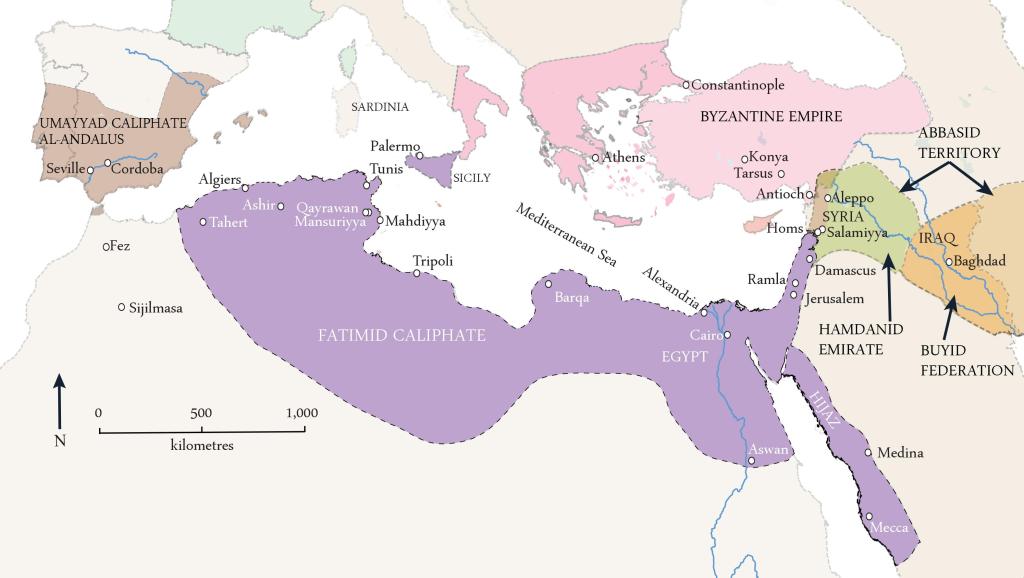
The Fatimid Caliphate was a Ismaili Shia caliphate that existed from the early 900’s to the late 1100’s and spanned quite a large part of North Africa (above is a map to show you the scale of the state); the caliphate was ruled by the Fatimids a dynasty that claimed descent from the Prophet’s daughter Fatimah. This as you can imagine gave them quite a prestige. Now Sitt al Mulk was born in the city of al-Mansuriya in Ifriqiya (modern day Tunisia) into a prime position within her dynasty; her father was Al-Aziz Billah the youngest son of the then caliph Al-Mu’izz li-Din Allah. Sitt was born in 970 at the peak of the Fatimid’s success and just a year after her grandfather had conquered Egypt; this meant that although she was born in Tunisia, she grew up mostly in Egypt at the Qasr al-Bahar palace on the shores of the Nile. At the point she was born though, her father wasn’t the heir to the throne and he certainly wasn’t expected to one day run the show (he had two older brothers). Hence why in his youth he was allowed to take an unnamed slave girl to be his concubine and then have a child with her (that child being Sitt); the girl we believe is the “al-Sayyida al-Aziziyya” referred to in various sources although like most slaves/concubines her birth name is unknown. What we do know is that she was a Christian, most likely a Greek-speaking Melkite Christian from the Byzantine Empire. Where in the Byzantine Empire is open to interpretation; I’ve seen some suggestion she was potentially from Sicily but the Byzantine Empire was so vast she really could have come from anywhere. The interesting thing about Sitt al Mulk’s mother was that she outright refused to convert to Islam, and Al-Aziz was so head over heels in love that he allowed it. Once again I emphasise the fact that he wasn’t initially expected to become the sovereign so his concubine refusing to convert to Islam wasn’t necessarily seen as the biggest scandal. It was frowned upon certainly but it wasn’t a scandal. That is until a series of chaotic dynastic events led to him becoming the Caliph in 975. That’s where her Christian status became an issue, especially as the Fatimid’s were fighting a Holy war against the Byzantines in what is now Syria. Awkward. Despite the intense disapproval that radiated from senior religious figures in the caliphate, Al Aziz refused to dismiss her and “not only did her mother remain al-Aziz’s favorite long after he rose to the Fatimid throne in 975, she remained so until her death twenty years later” [1]. Sitt al Mulk was thus the product of a mixed marriage as her parent’s only child and rather than be ashamed of that fact, we have ample evidence that clearly shows she was “proud of her double identity and defended it as an ideal” [2]. Now I call her, her parent’s only child. That I must admit is open to interpretation. Her father had a son Al-Hakim (remember him, he’ll become important later!!!) however the identity of his mother is unknown; some sources such as William of Tyre state that Al-Hakim and Sitt al Mulk shared a mother however the Fatimid historian al-Musabbihi (970-1030) recounted a story in which Al-Hakim’s mother is clearly presented as a Muslim. We know for a fact that Sitt al Mulk’s mother was not. Also because her faith was so controversial, the identity of Sitt al Mulk’s mother is really emphasised in sources, I find it hard to believe that there wouldn’t be the same emphasis if she were also Al-Hakim’s. There was also a significant age gap (15 years) between Sitt al Mulk and her brother and that’s a pretty long time between pregnancies; obviously there’s a possibility her mother had miscarriages/stillbirths etc that were not recorded in the years after Sitt al Mulk’s birth but the age gap does make it seem unlikely the same woman gave birth to them both. Now the religious beliefs of Sitt al Mulk’s mother clearly had an undeniable effect on Al-Aziz and the way he ran the caliphate; it’s a well known fact that “under his rule non-Muslims – Christian’s and Jew’s had the rights to privileges they had never had before. They had access to the highest offices of the empire; they participated in all political activities, making decisions and acquiring a pre-eminence that aroused jealously” [3]. Most of Al-Aziz’s contemporaries and indeed the majority of historians in the centuries since, seem to believe his religious tolerance was a direct result of his relationship with Sitt al-Mulk’s clearly influential mother. As I noted, Sitt al-Mulk was raised to believe in religious tolerance and harmony between the different religions; she was also raised to have opinions. Al Aziz was by all accounts a loving father and doted on his daughter, securing her an impressive education and encouraging her to express her opinions which despite her tender age, he often took into consideration. As she grew older, her involvement in politics and the extent to which her father listened to her intensified and it’s likely that she was frequently approached by those wanting to curry favour with her favour as evidenced by the actions of the vizier Isa ibn Nasturus, who after being dismissed from his post tried to regain his position through her intercession. Unlike European princesses who were married off for political alliances, the Fatimid dynasty had a common practise of princesses remaining unmarried in order to avoid dynastic complications, a tradition that Al Aziz followed by keeping his daughter unmarried. This is one reason she managed to accumulate so much wealth and influence; by remaining unmarried and at her father’s side, she therefore remained close to power. Now I’d like to emphasise that the wealth and influence that Sitt al Mulk managed to accumulate so early in life, was not a common theme in the Fatimid caliphate. She majorly stands out amongst the other Fatimid princesses.
On the 14th October 996 Sitt al Mulk’s world changed forever when her very tolerant and very popular father died suddenly and unexpectedly leaving Sitt al Mulk’s younger brother Al-Hakim then just 11 years old, the new Fatimid Caliph. Now the interesting thing about the Fatimid’s is that they didn’t follow the practise followed by European monarchies which automatically designated the eldest son the heir; the Fatimid’s succession rules however allowed for the Caliph’s to “designate his own successor” [4]. Prior to his unexpected and sudden death, Al-Aziz had evidently at some point designated Al-Hakim, his heir, and so the young boy was crowned almost immediately. The peaceful and completely successful transfer of power from father to son was vital as it demonstrated to the rest of the world the stability and strength of the Fatimid dynasty. On that front Mission Accomplished. At that point Al-Hakim was just 11 years old and so no-one could have foreseen how disastrous he would become. Despite the seemingly peaceful transfer of power there was still some drama behind the scenes; the various Shia factions whose influence had been eroded under Al-Aziz sought to get some of that power back and they tried to monopolize government which caused significant drama not just with the Christian and Jewish factions that had flourished under Al-Aziz but also caused clashes with the Circassian Turkic slave soldiers. This tension-filled situation went on for months; we don’t know how involved Sitt al Mulk was in the political shenanigans however considering her status as the highest ranking woman in the dynasty, it’s likely she had some involvement. Al-Hakim’s tutor Barjawan was able to seize the reins of government for himself in 997 and he remained de-facto regent for three years demonstrating a talent for balancing power between the various factions and for encouraging the rise of men of diverse backgrounds. In 1000 however Al-Hakim now 15-years old decided he was ready to take power himself. Suffice to say it did not end well.
Now in the initial years of Al-Hakim’s reign, the two siblings seemed to have had a relatively civil relationship; although there’s little information, we do have evidence of her presenting him with rich gifts in 997 and in 1000 he granted her a significant annual income of 100,000 gold dinars [5]. There’s also some evidence that she intervened occasionally in the politics of the state and was considered significantly influential; Al Hakim ordered the the execution of the vizier Abu’l-Ala Fahd ibn Ibrahim due to his involvement in a conspiracy, after being informed of the conspiracy by Sitt al-Mulk who had caught wind of it [6]. She was also the only member of the royal family during his reign to act as a patron of architecture, funding the construction of baths, wells, reservoirs and even a mosque [7]. The relationship however seems to have deteriorated as Al-Hakim became increasingly erratic and his actions increasingly irrational. Many historians have put forth the idea that Al-Hakim suffered from some sort of mental illness with S.D Goitein describing him as “the interesting psychopathic caliph” [8]; this idea dominates academic analysis of his reign. I’ve mentioned repeatedly on this blog that I’m not a fan of diagnosing historical figures with mental health illnesses however I can admit that Al-Hakim’s actions lack any degree of logic and it’s entirely possible that mental health played a part in his behaviour. Regardless of what caused his actions, we do know that as the years went by Sitt al Mulk began to oppose his policies, particularly in regards to religion. The Fatimids had long had a policy of religious tolerance and as previously mentioned religious minorities fared well under Sitt al Mulk and Al-Hakim’s father who was more tolerant that most. Al-Hakim initially followed in his forefather’s footsteps and there are accounts of him visiting monasteries whilst there are some contemporary Christian and Jewish sources that speak positively of him, including the story of him supporting Ibn Raga a Muslim who was imprisoned by his family after he converted to Christianity. The family attempted to force him to convert back to Islam, however the story goes that Al-Hakim intervened and allowed Ibn Raga to remain a Christian [9]. That was in the early years of Al-Hakim’s reign, probably whilst his regent Barjawan controlled government. From 1003 onwards a number of sumptuary laws against religious minorities began to be established; it was from 1005 onwards with the revolt of the North African rebel Abu Rakwa, that Al-Hakim’s religious policy shifted and not in a way that his sister appreciated. It wasn’t just religious minorities that suffered under Al-Hakim’s authority; certain sects of Islam also began to be attacked. It was the Christian community however that suffered the most and after 1005 Al-Hakim instituted a program of church demolition throughout his realm, culminating in the destruction of the Holy Sepulchre in Jerusalem, a monumental act that the European’s would later use as impetus to launch the Crusades. Imagine making a decision that caused the Crusades?! Now the date of the Holy Sepulchre’s destruction isn’t completely clear; some sources state 1007 whilst Christian sources favour 1009 or 1010. What we do know is that in the aftermath he embarked “on an intensified program of church destruction and persecution of Christian’s and Jews” [10]. Sitt al Mulk by all accounts, a woman born of a Christian mother, was deeply unimpressed with his religious policy and the two grew apart; historians have suggested other causes for their deteriorating relationship including Al-Hakim’s apparent disapproval of his sisters influence and the fact that he suspected she had taken various lovers including some of his generals [9]. There’s no evidence suggesting that his suspicions were true however it’s possible. Tensions between the siblings appear to have come to the forefront of Fatimid politics in 1003 when he named their cousin Abd al-Rahim ibn Ilyas as the heir to the throne; his choice of heir violated the direct line of succession and overturned a century of precedent of excluding the males of the wider dynasty from all affairs of state. What was bizarre about Al-Hakim naming his cousin the heir to the throne was that he had two sons of his own; most kings prefer their own sons inheriting the throne after them so pretty much everyone was baffled at Al-Hakim’s choice. It’s believed by some historians that Al Hakim loathed the public aspect of his role and naming Abd al-Rahim ibn Ilyas as the heir to the throne was a way of avoiding his public duties; Abd al-Rahim ibn Ilyas could thus act as “a symbolic stand in who could assume the ceremonial function of the imam but not the actual position” [11]. Regardless of the why, what we do know is that Sitt al Mulk for one was pissed and openly objected to her brother’s decision, favouring the succession of Al-Hakim’s son Ali. She appears to have a pretty close with her nephew; not only did she take Ali and his mother into her palace to protect them from Al-Hakim but at some point in the years afterwards (although I have no idea when) she appears to have formally adopted Ali [12] which gave him some extra claim on the succession. In either 1014 or 1015, Al-Hakim had one of his favourites Malik ibn Sa’id al Fariqi who he had previously raised to the head of the judiciary executed, apparently due to Malik siding with Sitt al Mulk on the matter of succession. For the rest of Al Hakim’s reign, the relationship between the two siblings appears to have been distant with Sitt al Mulk effectively founding her own court separate from his (it’s super important to note that Sitt al Mulk having her own court speaks to how influential she was; she is the only known “woman of this period said to have one” [13]).

Al Hakim’s erratic and at times violent reign came to an abrupt end on the 13th February 1021, when he disappeared during one of his bizarre nightly walks in the streets of Cairo. Some sources claim that seven days later on the 20th February Sitt al Mulk took charge and promptly had her nephew Ali installed as the new sovereign with the regnal name Al-Zahir li-i’zaz Din Allah although other sources claim that his coronation didn’t take place until a month later on the 27th March. The question of what happened to Al Hakim has never been answered although historians tend to agree that he was probably killed on that fateful night on the 13th February. There are three main contemporary sources who wrote about Al-Hakim’s disappearance at the time; the first Hilal al-Sabi directly blamed Sitt al Mulk claiming that she had conspired with the Kutama general Ibn Dawwas (one of her alleged lovers) to have Al-Hakim killed. Despite the contemporary nature of Hilal’s claims, it’s important to note that many of his works are heavily anti-Fatimid and so should probably be looked at with a grain of salt. Yahya of Antioch a Christian who had fled al-Hakim’s persecution, however mentions nothing of Sitt al-Mulk’s involvement in al-Hakim’s death in his writings. Historians are unsurprisingly divided on whether Sitt al Mulk had her brother murdered; Yaacov Lev and Fatima Mernissi both find her involvement likely whilst the likes of Heinz Halm find it dubious. Historians who tend to doubt her involvement often point to the very long list of people within the Fatimid state who wanted to get rid of Al Hakim. I personally think she probably was involved; it’s possible her involvement was minimal. At the bare minimum I think she probably gave her consent to his murder however it’s also possible she was outright the mastermind behind the whole thing. I just find it unlikely she had no involvement. The death of Al-Hakim left Sitt al Mulk as the de facto ruler of the state and she quickly set about reversing many of Al-Hakim’s questionable policies including his religious ones, allowing those who had been forced to convert to Islam to return to their original faiths. She also reversed his policies on confining women to their homes, the banning of music and wine, the abolition of certain taxes and she sought to repair relations with the Byzantine Empire which had suffered majorly under Al-Hakim. Sitt al Mulk’s role as de facto ruler sets her apart from pretty much every other Fatimid woman, as the women of the dynasty were not usually involved in politics in fact they rarely had communication with the outside world, with agents usually acting on their behalf. Sitt al Mulk’s very public, very prominent role in the politics of state was unprecedented in Fatimid history and would not be reciprocated. She proved to be a pretty competent leader and contemporary medieval chroniclers praised her leadership. She remained in control of the state until she died which likely happened in 1023.

So there it is! I find Sitt al Mulk so fascinating and am thrilled I was able to write this post. See you all soon
Alexandra x
References
[1]. Paul E. Walker, “The Fatimid Caliph al-Aziz and His Daughter Sitt al-Mulk: A Case of Delayed but Eventual Succession to Rule by a Woman”, in Journal of Persianate Studies, Vol 4, pp 30-44.
[2] Fatima Mernissi, “The Forgotten Queens of Islam”, trans by Mary Jo Lakeland, (Polity Press, Cambridge, 1993), p. 161.
[3] Fatima Mernissi, “The Forgotten Queens of Islam”, trans by Mary Jo Lakeland, (Polity Press, Cambridge, 1993), p. 160-161.
[4] Paul E. Walker, “Succession to Rule in the Shiite Caliphate”, in Journal of the American Research Center in Egypt, Vol 32, (1995), p. 240.
[5] Yaacov Lev, “The Fatimid Princess Sitt al-Mulk” in Journal of Semitic Studies, Vol 32, (1978), pp 319-328.
[6] Yaacov Lev, “The Fatimid Princess Sitt al-Mulk” in Journal of Semitic Studies, Vol 32, (1978), pp 319-328.
[7] Marina Rustow, “A petition to a woman at the Fatimid court (413-414 / 1022-1023 CE)”, Bulletin of the School of Oriental and African Studies, University of London, Vol 73, No.1, (2010), p 12.
[8] Jennifer Pruitt, “Method in Madness: Decontextualising the destruction of churches in the Fatimid Era” in Muqarnas, Vol 30, (2013), p. 123.
[9] Jennifer Pruitt, “Method in Madness: Decontextualising the destruction of churches in the Fatimid Era” in Muqarnas, Vol 30, (2013), p 128.
[10] Fatima Mernissi, “The Forgotten Queens of Islam”, trans by Mary Jo Lakeland, (Polity Press, Cambridge, 1993)
[11] Paul E Walker, “Succession to Rule in the Shiite Caliphate”, Journal of the American Research Center in Egypt, Vol. 32 (1995), p. 247.
[12] Paul E Walker, “Succession to Rule in the Shiite Caliphate”, Journal of the American Research Center in Egypt, Vol. 32 (1995), p. 247.
[13] Marina Rustow, “A petition to a woman at the Fatimid court (413-414 / 1022-1023 CE)”, Bulletin of the School of Oriental and African Studies, University of London, Vol 73, No.1, (2010), pp. 12.
Other Sources:
Nada Mourtada-Sabbah and Adrian Gully, “I Am, by God, Fit for High Positions’: On the Political Role of Women in al-Andalus”, British Journal of Middle Eastern Studies, Vol 30, No.2, (2003), pp 183-209.

 The Monstrous Regiment of Women