I’m going to go out on a limb here and say that very, very few people have never heard of Joan of Arc. In the centuries since her death she’s taken on this semi-legendary larger than life persona; in France, she’s a national hero, a rallying figure for French nationalism whilst internationally she’s often seen as a symbol of liberation and martyrdom especially by the Catholic Church who canonised her in 1920, four hundred and eighty one years after her horrific death. Although the Hundred Years War carried on for two decades after her death, her aggressive tactics and military strategy is said to have influenced the French campaign until the very end. If we’re being honest, The Hundred Years War was really just a cluster-fuck of men making questionable decisions however contrary to the narrative of every conflict ever, it was not a solely male affair; there were a few women that played a significant role in the war. Joan for example is one. My girls Isabella of France, Catherine of Valois and Isabeau of Bavaria were all present at various points of the war and all had their part to play. Isabella in particular has been the subject of many a study over the century and remains to this day pretty controversial. There was one woman in particular who had an undeniable effect on both the events of the conflict and indeed the outcome but who has been infuriatingly left out of many history books. As Nancy Goldstone writes of her; “only a power broker this masterful, a descendant of royalty possessed of the requisite administrative, diplomatic and logistical skills could have hoped to succeed at so demanding a task. Although this statesman’s influence over the events of her time was unparalleled, neither her achievements nor her dominance has ever been recognised. Even her name has been forgotten. She was Yolande of Aragon” [1].
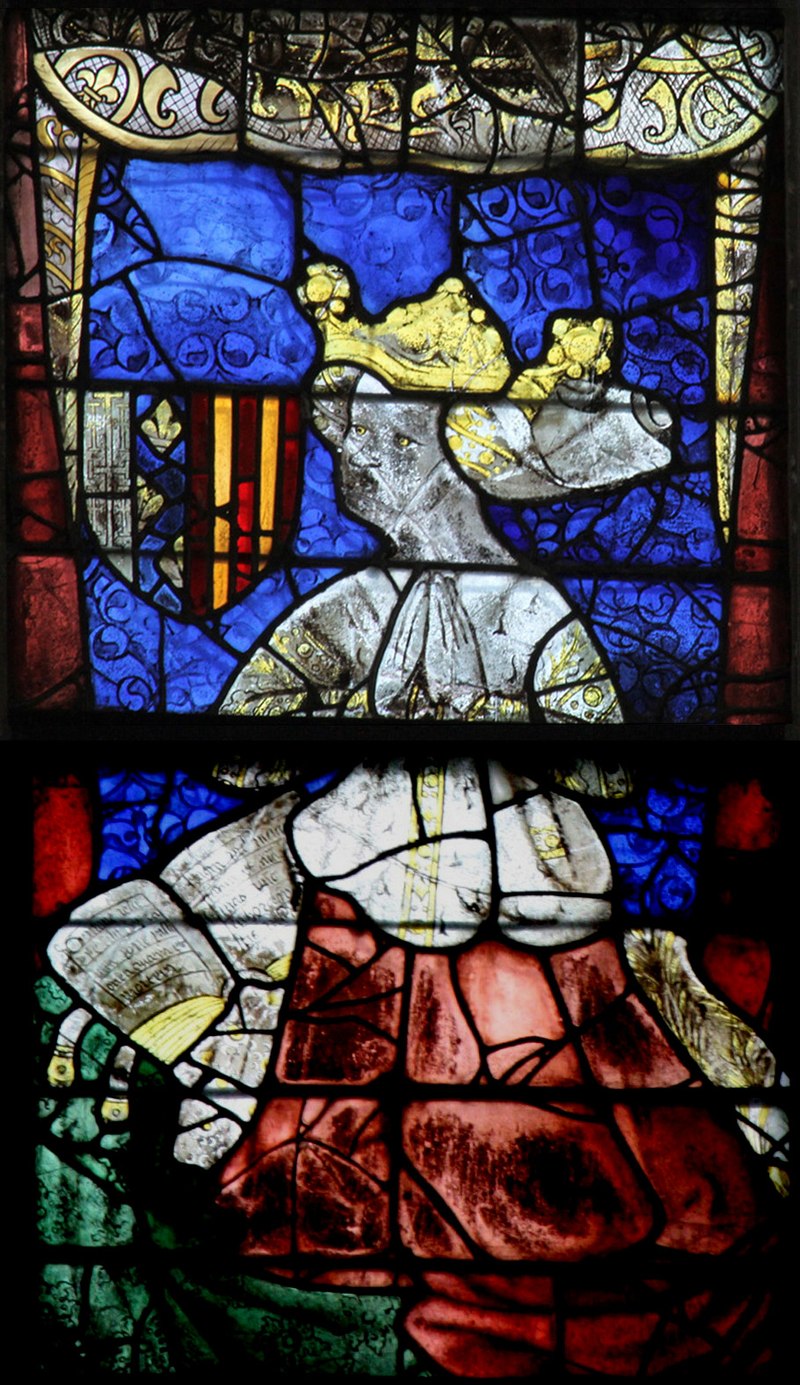
Yes ladies and gentlemen, today I will be introducing you to the powerhouse that was Yolande of Aragon. Yolande was born in either Zaragoza or Barcelona on August 11th 1381 the daughter of John the then heir to the throne of Aragon and his second wife Yolande of Bar. John was the son of the pretty formidable Peter/Pedro IV King of Aragon and Eleanor of Sicily and brother of the Queen of Castile whilst the elder Yolande was the daughter of Robert I Duke of Bar and Marie of France aka the sister of Charles V King of France. The younger Yolande was pretty much as blue blooded as they come and born right in the middle of European royalty. She was the second of her parent’s seven children but the only one to actually make it past 18. In fact her father altogether had twelve children; five from his first marriage to Martha of Armagnac (a French princess) and seven from his second marriage (to another French princess). Out of those twelve children, only Yolande and her elder-half sister Joanna survived childhood which lets be honest is pretty disastrous as far as Kings go. Now Yolande was born prior to her father’s accession, and at the time of her birth her grandpa Peter or Pedro IV was on the throne of Aragon. He didn’t just rule Aragon though. He also ruled Valencia, Barcelona, Catalonia, Majorca, Sardinia, Sicily and Malta. Known as Peter/Pedro the Ceremonious, he had ruled for almost 5 decades by the time Yolande was born and was a major player in European politics. He died when she was around 6 and her father became king. Something I’m always fascinated by when researching female historical figures like Yolande is looking at their upbringing; I’m the daughter of a social worker and I know my mum’s always emphasised how significant someone’s upbringing is, in regard to the adult they later become. Yolande’s parents were a pretty perfect match and were both lovers of fashion, music and literature whilst her maternal grandmother Marie was a voracious reader who ensured her daughters and granddaughters received an extraordinary education [2]. Under her father’s rule, Aragon was one of the centres of European culture and “to grow up, as Yolande of Aragon did, in this particularly artistic atmosphere was a unique experience in Christendom. Other European courts patronised troubadours and encouraged the literary arts, of course, but nothing like this. The point was not simply to learn to read, write and perform verses, stories or songs but to incorporate the art into daily existence – to live poetry” [3]. She also grew up in a family dominated by powerful women and in fact there were four women that likely had a huge influence on her. The first was her maternal grandmother Marie of France Duchess of Bar who as I noted was a renowned collector/reader of literature and to whom Jean d’Arras dedicated his Roman de Melusine. The second was her paternal grandmother Eleanor of Sicily who had been extremely politically active and was noted to have attended parliamentary assemblies in her husband’s absence. The third was her mother Yolande who was often the one running the show in Aragon due to her father’s frequent bouts of illness, effectively serving as “his lieutenant from 1388 to 1395” [4]. The fourth was her aunt Maria de Luna (the wife of her father’s brother/successor Martin) who exerted pretty considerable influence throughout Martin’s reign. The latter three women were not only Queen Consorts of Aragon but also served as “proactive queen-lieutenants” [5]. Yolande’s idea of Queenhood was thus vastly different to what many think of medieval queens nowadays; powerless, submissive, oppressed. None of the women in Yolande’s life were any of those things and it’s pretty likely the witty, intelligent and educated princess benefitted from “the great exposure to the business of co-government and the phenomenon of absent or reluctant kings, unable or disinclined to involve themselves in the trickier political issues of their rule. Absent, ill or incapable, Iberian kings understood that they needed the open involvement of their queens in order to rule effectively” [6]. It’s hard not to see how such an upbringing created the woman that Yolande became. (Below are effigies of her parents)

Now the politics of the period are so super complex and to explore the relationships between all the different European countries would take up several posts alone so I’m not going to do that. All you need to know is that the continent was a hot mess where alliances changed almost daily and all the royals were somehow related to one another. The same year (1381) that Yolande was born, another event of significance took place in European politics. Joanna I Queen of Naples, Jerusalem and Sicily was on the verge of being invaded and so in a mad scramble for allies, offered to name her distant cousin Louis I Duke of Anjou as her heir on the condition he came to her aid. Now Louis was the brother of Charles V King of France and Yolande’s grandmother Marie of France thus making him her great-uncle. Louis unsurprisingly liked the idea of being King and so jumped at the chance. It didn’t however work out quite as he liked; by the time he arrived with his impressive army, Joanna was dead and the kingdom was held by her rivals. Louis was never able to gain control of the kingdom that had been promised to him and died two years later. Now that might have been the end of that if he had been married to anyone else but Louis’ wife Marie of Blois was quite frankly incredible and one of the many examples of why medieval Europe would have been a better place had the women run the show. In the words of Nancy Goldstone, “if the councillors to the court of Aragon thought Yolande of Bar an ambitious woman who meddled too much in affairs of state, in Marie of Blois they were about to get an education as to what a resolute and indefatigable female could achieve in the political arena when she set her mind to it” [7]. Marie was convinced the Sicilian throne should go to her eldest son Louis II and decided to dedicate her life to making sure that happened.
Unfortunately for her someone else had their eye on the Sicilian prize; Yolande’s grandfather Peter/Pedro IV who through his marriage to her grandmother Eleanor of Sicily, had a claim to the throne. This as you can imagine caused some tension between the houses of Anjou and Aragon and Marie threw herself into making sure she got shit done. There were two tasks in particular that she needed to deal with; the first was to have her son recognised as Louis II Count of Provence, a daunting task considering the rowdy Provencal barons that had all but rebelled after her husband’s death and the second was to find him a wife despite little Louis being no more than seven years old. He had in fact been engaged since 1382 when Louis I had arranged for him to marry Lucia Visconti. Her father however was imprisoned in 1385 and that brought an end to that. Marie briefly considered marrying her son to Giovanna the daughter of her husband’s sworn enemy Charles of Durazzo although Louis outright refused and so nothing came of the idea [8]. Finding a wife for her son was evidently important. Securing Provence even more so. Now the story of how Marie of Blois secured Provence for her son is very impressive and Kings from every era of history could learn a thing or two. Jehan de Bourdigne sums it up pretty well writing, “for certain this lady was very astute in her ability to determine who could serve and help her….and for magnanimity and courage of heart she exceeded many of the princes of her time and for this reason was greatly feared, prized and esteemed” [9].
The tension between the houses of Anjou and Aragon calmed down a bit when Peter/Pedro died and his son John (aka Yolande’s father) became King of Aragon. He was far less focused on the issues in Italy; he was after a Francophile and was far more interested in renewing close relations with his neighbour. This is super important because the House of Anjou was technically a branch of the French royal family and Louis a nephew of Charles V and first cousin to Charles VI. France took advantage of the French-loving new King of Aragon and in April 1387 a vast treaty was signed between the two kingdoms which agreed among other things, that France and Aragon would assist one another when possible with military equipment including galleys, lances and men at arms and that they would be “true, sincere and faithful friends” [10]. Later that year Louis II entered the Provencal capital of Aix as the official Count of Provence with his mother having dealt with the rebels. 1387 was also the year that negotiations began with the intention of arranging a marriage between Louis and Yolande. Negotiations began in 1387 but they did not finish in 1387. They went on for YEARS. This was because of a whole host of shitty political issues including the demanding nature of Louis’ French uncles who demanded a phenomenal dowry [11] and the hesitance of Yolande’s parents to marry their very pretty, very precious daughter to a king who didn’t technically have control of his kingdom. Yolande’s parents rightfully concluded that the French side were getting more out of a possible marriage than they were. The negotiations fluctuated for years and seemed pretty much finished in 1394 when thirteen year old Yolande signed a legal document disavowing any previous “promise made by her or her ambassadors on the grounds that those had been wrung from her before she reached thirteen, the age of consent” [12]. Richard II King of England then threw a spanner in the works a year later by proposing marriage to Yolande despite she being not yet fourteen years old and he a grown man of twenty three. Her parents were a bit more enthusiastic to that match however then her father died suddenly and the decision of who Yolande wed fell to her father’s successor/her uncle Martin. On Marie’s urging, her nephew Charles VI offered his own daughter Isabella to Richard and then had his ambassadors turn on the charm to win over Martin who seemed in favour of marrying his niece to Louis. Yolande however announced to the world that she was not open to the idea, having come to the realisation that by marrying Louis she would have to support French ambitions in Italy over the ambitions of her native Aragon. She was however ultimately a woman in a man’s world, and in 1399 was basically forced into marrying him by her uncle who willingly paid the ridiculously expensive dowry and sent her packing to Provence where Louis was waiting, having spent the last nine years in Naples. Having forced her into the marriage, her uncle couldn’t even be bothered to attend the wedding which took place in December 1400, thirteen years after negotiations first began. A cute little anecdote from the wedding was that Louis having heard about the supposed beauty and charm of his future wife no longer wanted to wait in Arles to see her so rode to Montpellier and watched the royal procession in disguise [13]. How beautiful was she, you may ask? Well according to chronicler Jean Juvenal des Ursins who knew her, she was “one of the most beautiful creatures that one could see” [14]. I’m guessing he’s trying to curry favour with that compliment, which seems OTT to say the least. She was however definitely considered a great beauty in that era. Beauty however was only one of her many attributes.

She was charming, witty, educated, a fashionista and extremely intelligent; basically everything Louis could have wanted her to be and he seemed to recognise that he was a VERY lucky man. In fact the two seemed equally as smitten with one another, despite Yolande’s less than enthusiastic sentiments towards her new husband on their wedding day. The marriage may have begun as a solution to a political problem but it became a love match, a partnership that produced five children, was by all accounts happy and loving and to top it off neither were ever accused of infidelity or scandal which as far as royal marriages go is pretty good. In fact Jehan de Bourdigne recorded that “it was joyful to see the warm, fervent, love between these two young people” [15]. The early years of the marriage were especially pretty fab; they were young and in love blessed with eye watering wealth and a growing family with Yolande falling pregnant a year into the marriage. Their first child Louis was born in September 1403. It wasn’t all fun and games and babies though. Louis II was determined to win back Sicily and so left his other provinces; Maine and Anjou in the north and Provence in the south, under the control of his new wife whose upbringing as the daughter of Aragon came in incredibly useful. As did the fact she had a powerhouse of a mother in law that taught her the ropes. As Louis’ wife, Yolande had to settle disputes between barons, oversee the collection of customs and rents, dictate the cost & collection of taxes and keep the peace. She had to do all this whilst her husband fought for his throne.
Another major issue that Yolande and Louis had to deal with was the shambolic state of affairs in France; at this point the Hundred Years War was in full swing and to complicate matters further the King of France was insane, and I mean that literally. Charles VI was Louis’ paternal cousin; Charles’ father Charles V had been the elder brother of Louis’ father the Duke of Anjou (as previously mentioned he was also the elder brother of Yolande’s grandmother Marie of France). Charles had inherited the throne as a child and the early years of his reign had been dominated by various powerful nobles including Louis’ father who had been one of several regents. He had eventually taken control of the country himself and initially seemed to do a pretty good job. That however changed as his mental health began to deteriorate. Now we don’t know exactly when Charles’ mental health issues began to appear nor do we know what exactly he had; we do know that his first major bout of insanity occurred in 1392, when someone tried to murder a close friend/advisor of his, causing a breakdown. It’s possible there were smaller, less significant signs of insanity prior to 1392 but nothing was ever recorded. 1392 was his first major bout of psychosis and it didn’t get any better. A year later in 1393 he had another serious bout during which he didn’t know his own name nor realise he was king [16]. The majority of studies I’ve read which try to diagnose Charles (seen below) point to schizoprehnia however I’m a little uncomfortable with diagnosing someone over six hundred years later.

A king unable to fulfil his duties causes all sorts of shenanigans, especially when there are a number of people willing to step in and do his duties for him. Even more so when those men are all royal dukes with equal claims to power and sensitive egos. Louis as the King’s cousin was one such duke. Charles’ brother Louis I Duke of Orleans was another, as was John the Fearless the Duke of Burgundy whose father Philip had been the youngest brother of Charles and Louis’ fathers (and Yolande’s grandmother). Charles’ uncle the Duke of Berry was also involved as were the dukes of Brittany and Bourbon. See what I mean about everyone being related? Its such a mess for that reason alone. All of the men mentioned above were heavily invested in the question of who ruled for Charles in his periods of instability and this led to what was initially a difference of political opinions and a childish struggle for power but became something else entirely. You see Charles was capable of ruling in-between his episodes. As the decade progressed however those episodes increased and by 1402 he was unable to rule at all. This led to his wife Isabeau of Bavaria having to act as a mediator between the feuding dukes all of whom wanted to be regent. She was granted control over the royal finances and in April 1403 these powers were formerly ratified when “Isabeau was acknowledged as the leader of a new regency council which included all the royal dukes, the Constable, the Chancellor and others of the King’s regular councillors” [17]. Isabeau having virtual control however didn’t stop the shenanigans of those at court from continuing and within a few years, French court was split into two factions; the Armagnac/Orleanists and the Burgundians. Isabeau was very much #TeamArmagnac, the faction that was led by Louis’ cousin the Duke of Orleans, so much so that she was openly accused of having an affair with her brother in law. It’s important to point out that whilst the two were admittedly very close, the rumours of a sexual relationship were widely spread by the English who the French were, you know, fighting a war with. If Isabeau’s sexual morality could be so questioned, so could the legitimacy/paternity of her sons. Now I have to say I wish we knew more about the relationship between Isabeau and Yolande, two very very prominent women in an era that wasn’t exactly nice to women (is any era though to be fair?). I’ve read very little that speaks to what type of relationship they had which is super disappointing.
Now the years 1402 – 1407 were very rocky with both sides reigning supreme at different points. Throughout this Louis and Yolande chose a policy of not really picking a side. They were after all also trying to take over Sicily and Naples so they were pretty busy. In French affairs however they were basically the Switzerland of the early 1400’s. This changed slightly in 1407 when the Duke of Burgundy decided to assassinate the Duke of Orleans in a sensational act that appalled just about everyone and shocked the entire country. It was a hell of a scandal and this ladies and gentleman is where a petty squabble over power turned into full blown civil war. Now the Duke of Burgundy somehow miraculously managed to get away with it, mainly by appealing to the extremely-paranoid mind of King Charles, convincing him that the Duke of Orleans was planning to commit regicide. There is 0 evidence of this, it’s ludicrous and the Duke of Burgundy is a douche. He however was pardoned by the King (I forgive Charles for this purely because he wasn’t sane enough to make such a decision) which to put it mildly very much upset the Duke of Orlean’s supporters including his wife Valentina and his son Charles. Violence and bloodshed followed. Louis and Yolande although appalled continued to be neutral and maintained civil relations with both sides. They were as I said dealing with other matters; Yolande’s uncle Martin had died in 1410 without a son and so Yolande had sent ambassadors to Aragon to determine whether her son Louis could inherit. Although ultimately the throne was given to her cousin Ferdinand, Aragon was forced to pay her “a settlement of 150,000 florins as compensation for her claim” [18]. She nonetheless continued to claim that Aragon was rightfully hers.
The violence in France continued, culminating in a mob attack on the Queen and her eldest son the Duke of Guyenne in 1413. During an uprising led by butchers and flayers, the Burgundians took control of the capital and egged on the mob to attack the Duke of Guyenne’s palace. They did, took fifty hostages and then promptly delivered those fifty hostages to the Duke of Burgundy’s Paris residence. A mob attack on the royal family was the final straw for Louis and Yolande who were openly furious and became true and devout members of #TeamArmagnac. They ended the engagement of their son to the Duke of Burgundy’s daughter and having raised her for several years promptly sent her back to her father. This was a pretty big insult and the Duke of Burgundy swore revenge. Yolande however took steps to ensure her family maintained powerful alliances and in October of that year Yolande and Isabeau met privately to arrange the marriage of Yolande’s eldest daughter Marie to Isabeau’s third son Charles (see below). I love the idea of Yolande and Isabeau being the ones to arrange this (Louis was out of the country at the time and therefore had little involvement). The alliance of Yolande and Isabeau gave the Armagnac side the upper hand and represented a change in the power dynamics of France. The Duke of Burgundy meanwhile was chased out of the city by the same mob he had encouraged leaving Isabeau feeling somewhat relieved. To celebrate she threw the mother of all engagement parties. The party atmosphere however didn’t last because by February 1414, it became known that the Duke of Burgundy had raised an army to march on Paris. Everyone made plans to protect themselves; Louis II took up residence in the Bastile to protect the capital whilst Yolande took her children and decided to stay at the family castle in Angers.

It wasn’t just her children however that she had custody of. You see Isabeau of Bavaria was not renowned for being a particularly doting mother and had faced accusations of ignoring her children, particularly the younger ones. Charles who was now engaged to Yolande’s daughter was the third of his mother’s sons and had, if we’re being honest had a pretty crappy childhood up until this point. His mother ignored him. His father was constantly in a state of psychosis. He had up close witnessed uprisings and violence and had spent most of his childhood under some form of house arrest, either by his mother’s enemies or his mother’s own guards in order to keep him safe. In 1414, however Isabeau gave custody of her son to Yolande, his future mother in law. Yolande in contrast to Isabeau was said to be a pretty loving parent who maintained close relationships with all of her children, even in adulthood. The Yolande-Louis family was a warm, loving and affectionate one which after a childhood of being neglected, seemed like heaven to Charles. His future brothers in law Louis and Rene became like his own brothers, he developed a close friendship with his future wife Marie and most importantly he became VERY close with Yolande who was pretty much the loving mother he had never had.
The close bond between the two would go on to be the saving grace of France. Something I’ll tell you all about in part 2!!!
Thank you for reading this, hope you enjoyed it.
Alexandra x
References
[1] Nancy Goldstone, “The Maid and the Queen: The Secret History of Joan of Arc”, (London, Weidenfeld & Nicolson, 2011), p. introduction xvii.
[2] Nancy Goldstone, “The Maid and the Queen: The Secret History of Joan of Arc”, (London, Weidenfeld & Nicolson, 2011), p.5-6.
[3] Nancy Goldstone, “The Maid and the Queen: The Secret History of Joan of Arc”, (London, Weidenfeld & Nicolson, 2011), p. 7.
[4] Theresa Earenfight, “Queenship in Medieval Europe”, (Basingstoke, Palgrave MacMillan, 2013), p. 227.
[5] Zita Eva Rohr, “The Practise of Political Motherhood in Late Medieval France: Yolande of Aragon, Bonne-Mere of France”, in The Image and Perception of Monarchy in Medieval and Early Modern Europe, ed by Sean McGlynn and Elena Woodacre, (Newcastle, Cambridge Scholars Publishing, 2014), p. 28-29.
[6] Zita Eva Rohr, “The Practise of Political Motherhood in Late Medieval France: Yolande of Aragon, Bonne-Mere of France”, in The Image and Perception of Monarchy in Medieval and Early Modern Europe, ed by Sean McGlynn and Elena Woodacre, (Newcastle, Cambridge Scholars Publishing, 2014), p. 29.
[7] Nancy Goldstone, “The Maid and the Queen: The Secret History of Joan of Arc”, (London, Weidenfeld & Nicolson, 2011), p. 17.
[8] Zita Eva Rohr, “Yolande of Aragon (1381-1442) Family and Power: The Reverse of the Tapestry”, (Basingstoke, Palgrave MacMillan, 2016), p. 17.
[9] Jehan de Bourdigne, “Chroniques d’Anjou et du Maine”, (Angers, Imprimerie de Cosnier et Lachese, 1842), qtd in Nancy Goldstone, “The Maid and the Queen: The Secret History of Joan of Arc”, (London, Weidenfeld and Nicolson, 2011) p. 19.
[10] Zita Eva Rohr, “Yolande of Aragon (1381-1442) Family and Power: The Reverse of the Tapestry”, (Basingstoke, Palgrave MacMillan, 2016), p. 16.
[11] Nancy Goldstone, “The Maid and the Queen: The Secret History of Joan of Arc”, (London, Weidenfeld & Nicolson, 2011), p. 20.
[12] Nancy Goldstone, “The Maid and the Queen: The Secret History of Joan of Arc”, (London, Weidenfeld & Nicolson, 2011), p. 20.
[13] Nancy Goldstone, “The Maid and the Queen: The Secret History of Joan of Arc”, (London, Weidenfeld & Nicolson, 2011), p. 22.
[14] Nancy Goldstone, “The Maid and the Queen: The Secret History of Joan of Arc”, (London, Weidenfeld & Nicolson, 2011), p. 22.
[15] Jehan de Bourdigne, “Chroniques d’Anjou et du Maine”, (Angers, Imprimerie de Cosnier et Lachese, 1842), qtd in Nancy Goldstone, “The Maid and the Queen: The Secret History of Joan of Arc”, (London, Weidenfeld and Nicolson, 2011) p. 25.
[16] Nancy Goldstone, “The Maid and the Queen: The Secret History of Joan of Arc”, (London, Weidenfeld & Nicolson, 2011), p. 36.
[17] Rachel Gibbons, “Isabeau of Bavaria Queen of France (1385-1422): The Creation of an Historical Villainess: The Alexander Prize Essay”, Transactions of the Royal Historical Society, Vol 6, (1996), p. 54.
[18] Nancy Goldstone, “The Maid and the Queen: The Secret History of Joan of Arc”, (London, Weidenfeld & Nicolson, 2011), p. 47.

 The Monstrous Regiment of Women
One thought on “Yolande of Aragon / The Woman That Won the Hundred Years War Part 1”